Lease buyout: when buying your leased car pays off
Buy your leased car instead of returning it? Who sells it, how the price and the residual value are related, when a buyout pays off and how Code 178 disappears from the vehicle registration document.
In short
- There is no legal right to buy; your contact is usually the supplying garage.
- The residual value is a calculated figure. The purchase quote and market value are what count.
- After payment, the leasing company releases Code 178, and you get a new registration document.
You know your car, it’s reliable, and you’d really like to keep it. A lease buyout can make that happen: you buy the car from the garage or the leasing company, at the end of the lease term or even earlier, provided they agree. Whether it pays off is decided not by the residual value in the contract, but by the price you actually pay and what the car is worth on the market today.
Lease buyout: who sells, and do you have a right to it?
The garage is your contact
The leasing company is the owner for the entire lease term. Even so, you usually deal with the garage where you got the car; in the contracts, it is called the supplier. Cembra describes it like this for its contracts: after the lease term, it usually returns the car to the supplier at the return value stated in the lease agreement. The supplier decides on the sale and sets a new price. So if you want to buy, you have to contact the supplier.
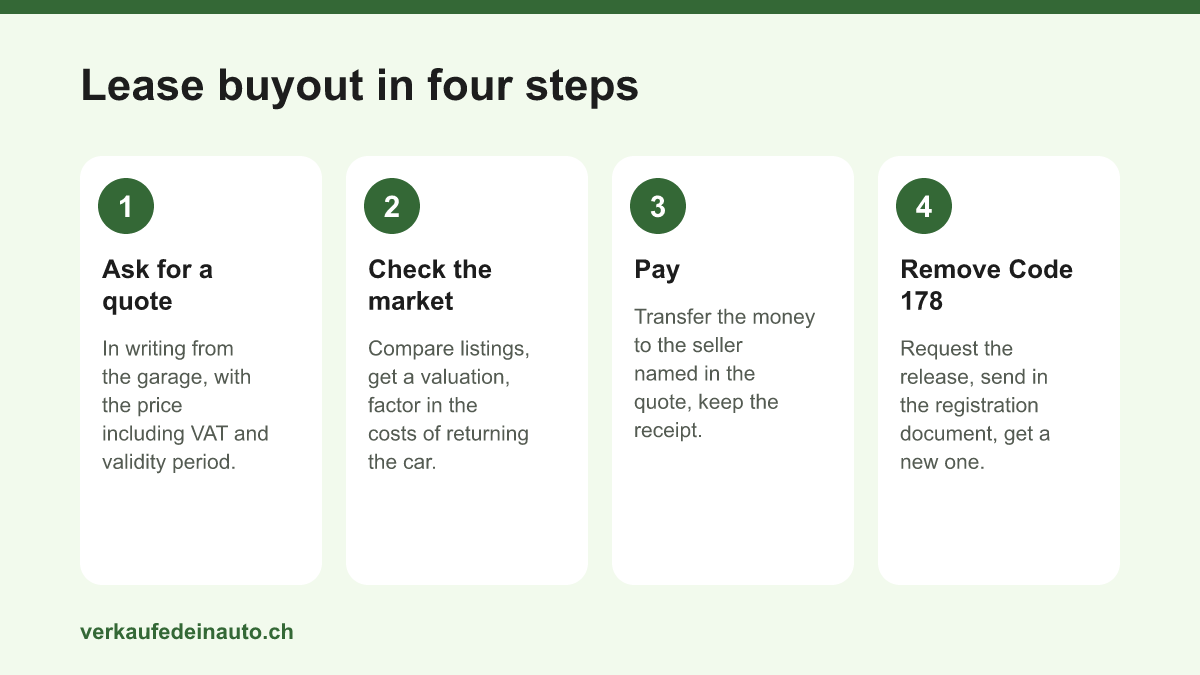
Contact your sales advisor about three months before the end of the lease and ask for a written purchase quote. Make sure it states who is selling, what the car costs and how long the offer is valid.
No right to buy
The Consumer Credit Act (KKG) does not give you a right to buy the car. The Swiss Leasing Association states that with classic consumer leasing, the car can only be acquired by mutual agreement. If the garage promised you something when you signed the contract, in practice you can only rely on what is in writing. Such a promise binds the garage, but it binds the leasing company only if it has also agreed in writing. What contracts say about the purchase option and the right of first refusal is covered in the article Right of first refusal and profit sharing in leasing.
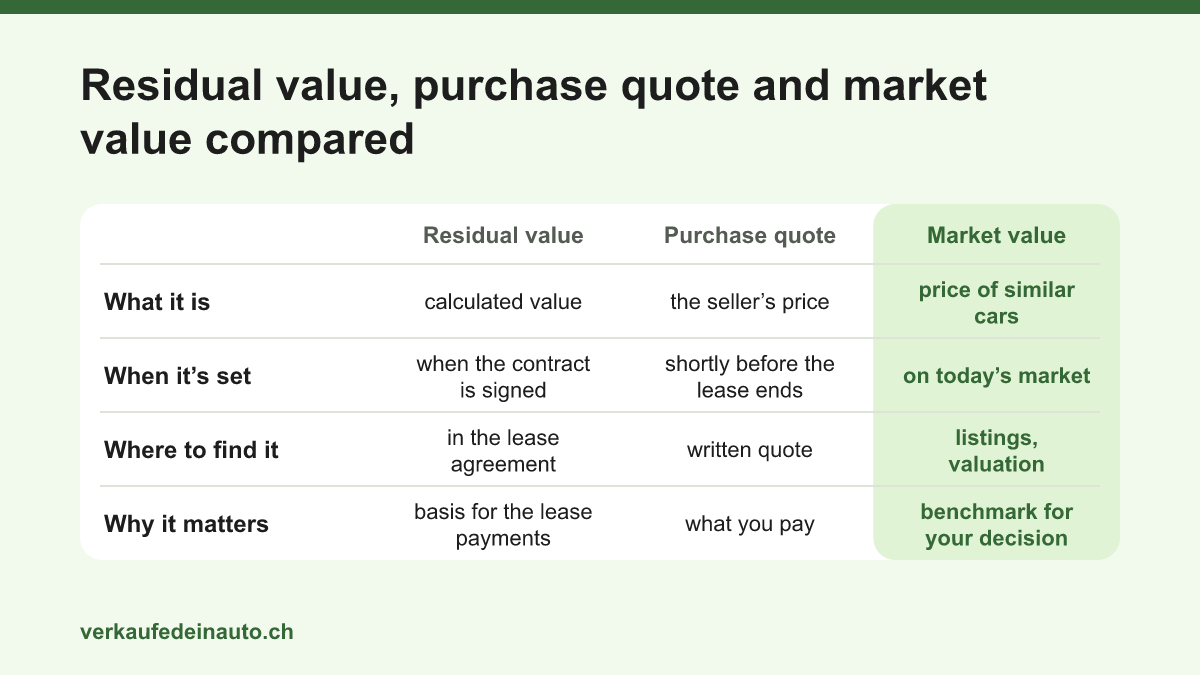
Residual value and purchase price are not the same
The residual value in the contract is a calculated value: it was set when the contract was signed in order to calculate the lease payments. It does not give you a right to buy the car for this amount. Some providers list buying the car for the residual value as an option. With others, the garage takes over the car at the value stated in the contract and sets a new selling price; whether it asks for the residual value or more is a matter of negotiation.
Check four points in the quote:
- VAT: The garage and the leasing company are almost always subject to VAT. Only compare amounts including VAT, and check whether the residual value in your contract is stated with or without tax.
- Excess kilometers and damage: Under the usual terms, both are charged at the end of the lease. Ask whether the garage waives them if you buy or bills them on top.
- Fees: Ask what is added for the quote, the termination of the contract and the vehicle registration document (Fahrzeugausweis), and have the total amount confirmed in writing.
- Security deposit: Find out how any security deposit you paid will be credited.
What is your car worth?
Get a free offer without obligation in a few minutes.
Does a lease buyout pay off? How to do the math
What counts is how it compares with the market. Search listing platforms for cars of the same year, with similar mileage and the same equipment, and get a valuation; our guide to car valuation shows how. Keep in mind that listing prices are asking prices. Then compare what each of the two options costs you in the end:
- Buying: the purchase price including VAT, plus costs that will soon come up, such as servicing, tires or repairs after the manufacturer’s warranty expires, and interest if you finance the purchase.
- Returning: excess kilometers and reconditioning under the contract, plus the price of a replacement car if you still need one.
Worked example with assumed figures
The garage offers the car for CHF 18’000 including VAT and confirms that this covers excess kilometers and damage. A comparable car costs around CHF 21’000 at a dealer; in a private sale, CHF 19’000 would be realistic. If you returned the car, you would be charged for 5’000 excess kilometers at 20 centimes and CHF 500 for damage, CHF 1’500 in total.
| Your goal | Option | Bottom line |
|---|---|---|
| Keep the car | return it and buy a replacement | CHF 22’500 in expenses |
| Keep the car | buy the leased car | CHF 18’000 in expenses |
| Do without a car | return it | CHF 1’500 in expenses |
| Do without a car | buy it and resell it | CHF 1’000 in income |
If you want to keep the car, buying it saves you CHF 4’500, and you are better off with any quote up to CHF 22’500. If you no longer need a car, buying and reselling leaves you CHF 2’500 better off than returning it; this pays off with a quote of up to CHF 20’500, but involves effort and the risk of reselling. If the garage charges the CHF 1’500 even though you buy, both advantages and both upper limits for the quote drop by CHF 1’500 each. If the quote is above the upper limit, returning the car is the better solution; the end of lease guide explains how the return works.
Paying and financing
Transfer the purchase price to the company named as the seller in the quote, and keep the contract and the proof of payment. If you don’t have the money in your account, there are two ways: a personal loan or follow-up financing that you apply for through the garage and pay off in installments. Both cost interest; the alternative to buying is extending the lease. Allow time: consumer loans come with a 14-day right of withdrawal (Art. 16 KKG), and the money is usually only paid out after that. The guide Selling a financed car explains what applies if you resell the car while the loan is still running.
Paperwork: sales contract, Code 178 and insurance
Ask for a written sales contract or an invoice with the vehicle details, mileage, price and date; the guide to the car sales contract shows what belongs in it. After that, the vehicle registration document still shows the entry “178 change of ownership prohibited” (Halterwechsel verboten). Without the leasing company’s consent, the road traffic office (Strassenverkehrsamt) will neither issue a registration document in the name of a new registered keeper nor delete the entry (Art. 81 VZV).
Here’s how the entry is removed:
- After payment, the leasing company releases the code electronically with the road traffic office. Request the release from the leasing company and have it confirmed to you; if the garage is the seller, check with the garage who will arrange this.
- You send the original vehicle registration document to the road traffic office of your canton or drop it off at the counter.
- You receive a new vehicle registration document without the entry.
You remain the registered keeper; no change of ownership is needed at the road traffic office. The fees differ from canton to canton: in the canton of Zurich, removing the entry is free, and you receive the new document by mail within five business days or immediately at the counter. In the canton of Bern, removing it without a change of ownership costs CHF 20 by mail and CHF 25 at the counter. Zurich also offers an online lookup: with the master number (Stammnummer) from the vehicle registration document, you can see whether the code is still recorded. For the days without the original, the canton of Zurich recommends carrying a copy and not driving abroad.
Don’t forget the insurance. Fully comprehensive cover was usually required by the lease agreement, and the claims under it were assigned to the leasing company. Tell your insurer about the purchase so that this assignment is lifted, and decide afresh what cover you need; the guide Comprehensive or partial cover helps with this. If the insurance was included in the lease, it usually ends with the contract: in that case, you need your own policy from the day of purchase.
Buying the car out before the end of the lease
You can also buy the car out during the lease term if the leasing company goes along with it. In this case, the lease agreement is terminated early and the car is sold. So you pay for two things: the additional payment for early termination, including fees, and the purchase price. The additional payment is based on the table in your contract: for contracts under the Consumer Credit Act, it shows what you have to pay if the lease ends early and what residual value the car has at that point (Art. 11 para. 2 let. g KKG). For the purchase price, only the quote you request through the garage is binding.
Tip
Before you order a settlement quote or a purchase quote, ask whether the calculation costs anything, and always ask for a date until which the amount is valid.
Reselling after the buyout, or selling directly
Once the purchase price is paid and the code is released, the car is yours to do with as you like: keep it, trade it in or sell it. If you only buy in order to resell, you have to advance the purchase price and need the leasing company’s release before the buyer can register the car. Once the release is in place, in the canton of Bern, for example, the code is removed as part of registering the car to the new registered keeper.
No pre-financing is needed as long as the contract is still running and the leasing company agrees to the settlement: a car buyer such as verkaufedeinauto.ch buys the leased car and settles up with the leasing company. You enter the vehicle details in the form, send photos and receive a firm offer; payment is made at the handover by instant bank transfer. The page Selling a leased car shows how it works. Get a free offer here and compare it with your garage’s purchase quote.
This guide provides general information and is not legal or tax advice. Your contract and the quote you receive are what count.
Frequently asked questions
Can I buy my leased car for the residual value?
Only if the seller agrees. The residual value in the contract is a calculated value for working out the lease payments, not a guaranteed purchase price. Some providers list buying at the residual value as an option; with others, the garage sets a new price. So ask early for a written purchase quote including VAT and compare it with the prices of similar cars.
Who issues the purchase quote for the leased car?
Usually the garage that delivered the car. With Cembra, for example, the car generally goes back to the garage at the agreed return value at the end of the lease, and the garage decides on the sale and the price. So call your sales advisor first. If the leasing company sells the car itself, you will also find this out from the garage or from the company’s customer service.
Do I have to pay for excess kilometers with a lease buyout?
The usual terms state that excess kilometers are charged at the end of the lease, so in principle also if you buy. Whether the garage waives them or factors them into the purchase price is a matter of negotiation. So get written confirmation that the purchase price settles all claims under the lease agreement, or ask for a breakdown of the additional items before you accept.
How long does it take for Code 178 to be removed?
First, the leasing company has to release the code electronically. You request this from the leasing company as soon as the purchase price has been paid. After that, it’s quick: in the canton of Zurich, you get the new vehicle registration document immediately at the counter and within five business days by mail. You can check online there whether the release has arrived, using the master number shown in field 18 of the vehicle registration document.
Can I resell the car right after the buyout?
Yes, as soon as you are the owner and the leasing company has released Code 178. Without this release, the road traffic office cannot register the car to a new registered keeper. Keep in mind that you pre-finance the purchase price and bear the risk of the resale. As long as the lease agreement is running, a car buyer can buy the car instead and settle up with the leasing company, if the leasing company agrees.
Sources
- Cembra: Leasing for private individuals – What happens after my lease agreement has expired?
- Swiss Leasing Association (SLV): Financing models for vehicles (in German)
- Consumer Credit Act (KKG), Art. 11 and 16 – Fedlex (in German)
- Road Traffic Licensing Ordinance (VZV), Art. 80 and 81 – Fedlex (in German)
- Canton of Zurich: Checking, requesting or removing Code 178 “change of ownership prohibited” (in German)
- Canton of Bern: Change of ownership prohibited, leasing Code 178 (in German)