End of lease in Switzerland: return, buy or extend?
Is your lease agreement running out? Here’s how returning, buying, extending and ending early work, with a timeline, guide values for wear and tear and a look at the final statement.

In short
- Contact the garage or leasing company about three months before the lease ends.
- At the return, you pay for excess kilometers and damage, not for normal wear and tear.
- You can only buy or extend if the garage or the leasing company agrees.
If your lease agreement runs out in the next few months, you have to decide: return the car, buy it, extend the lease or lease a new one. Your contract states your end of lease date, either as a specific date or as a lease term counted from the day the car was delivered. If you take care of it about three months ahead, you’ll have time for quotes and fewer surprises when you return the car.
End of lease: your options
The car belongs to the leasing company, even after the lease ends. Unless agreed otherwise, you return it on the last day of the contract. Anything else requires a new agreement with the garage or the leasing company.
| Option | What happens | Watch out for |
|---|---|---|
| Return | return to the garage with a report | excess kilometers and damage are charged |
| Buy out | purchase of the car | no right to it; the price is not automatically the residual value |
| Extend | new application for the same car | new lease payment; your creditworthiness is checked |
| Lease a new car | return and new contract | allow for the delivery time of the new car |
| End early | termination before expiry | lease payments are recalculated retroactively |
Returning the car: how the return works
As a rule, you return the car to the garage that delivered it. Arrange the appointment early: AMAG Leasing’s terms require the return appointment to be arranged at least four weeks before the end date. If you have less time left, call today. Never keep the car beyond the end date without a written agreement: under the same terms, the lease payments then continue.
The return report
At the return, the garage records the mileage, the condition and any missing parts in a report that you sign. Take your time reading it and have the reconditioning costs explained to you item by item. If you disagree, note your objections directly on the report before you sign; otherwise, with AMAG Leasing, you have to submit them by registered letter within five days. Never drop the car off at the garage without arranging it first or outside opening hours. Otherwise, under the same terms, the report that the garage draws up without you is deemed accepted.
If you can’t agree, terms such as those of AMAG Leasing and Santander Consumer Finance provide for an assessment by a neutral vehicle expert that is binding on both sides. If in doubt, the TCS recommends getting a second opinion from an independent expert, another garage or a TCS technical center. The easiest way is to get it before the return.
Normal wear and tear or damage?
Signs of use that come with normal driving are paid for with your lease payments. You are liable for damage, missing items and skipped maintenance. Your leasing company’s return catalog determines where the line is drawn; you can ask the company to let you see it. The wear and tear standards that the Swiss Leasing Association (SLV) developed with the garage association AGVS serve as an aid to interpretation. According to these standards, the following are tolerated, for example:
- fine paint scratches that can be polished out and don’t damage the primer: at most 30 millimeters long and two per body part
- soft dents under 20 millimeters in diameter that don’t need repainting: at most five on the whole car and one per body part
Things that are not tolerated include scratches that go down to the primer or can’t be polished out, hail damage, stone chips in the wiper area of the windshield, burn holes, a smell of smoke or animals, tires with 4 millimeters of tread or less and brake pads under 4 millimeters. According to the SLV, many contracts judge whether a flaw is noticeable from a distance of one meter. The newer the car and the lower the mileage, the stricter the standard. The standards are a guideline: what is agreed in your contract takes precedence.

What is your car worth?
Get a free offer without obligation in a few minutes.
Excess kilometers and the final statement
If you have driven more than agreed, you pay the rate set in the contract for each extra kilometer. An example with assumed figures: you agreed on 10’000 kilometers a year for four years, that is, 40’000. You have driven 46’000, and the rate is 15 centimes. That makes 6’000 × CHF 0.15 = CHF 900. Check whether the rate in your contract already includes VAT. You get nothing back for kilometers you didn’t drive; the terms of AMAG Leasing and Santander Consumer Finance say so explicitly.
The final statement can also include reconditioning costs, missing accessories, outstanding fees and an accident-related loss in value not covered by the insurance. If you paid a security deposit, it is settled after the return: outstanding claims are deducted, and you get the rest back. A down payment is not a deposit; it is factored into the lease payments and is not refunded at the regular end of the lease.
Checklist: how to prepare for the return
- Maintenance: have due services and repairs carried out where your contract requires, and have the service booklet updated.
- Report damage: report damage to the car to your insurer right away, not only at the return; the insurer usually pays for damage that is covered.
- Repair minor damage: first check the terms to see who is allowed to do body and paint work. With AMAG Leasing, you are liable for a loss in value if such work was not done by an official service partner of the brand. According to the TCS, a cheaper smart repair is sometimes enough.
- Original condition: remove your own add-ons and lettering without leaving a trace.
- Accessories: hand over all keys, the owner’s manuals, the service booklet and the vehicle registration document (Fahrzeugausweis), plus everything that was delivered or leased with the car, such as the second set of wheels. Winter wheels you bought yourself stay with you.
- Cleaning: clean inside and out, no personal belongings in the car.
- Records: bring the handover report from the day of delivery and photograph the condition, including the mileage, on the day of the return.
Tip
Show the car to the garage a few weeks before the return appointment and ask what they would object to. That way, you decide for yourself what to have repaired beforehand.
Buying the car instead of returning it
If you like the car, you can buy it at the end, provided the garage or the leasing company agrees. You have no right to this, and the price does not have to match the residual value in the contract. The lease buyout guide explains how to do the math, how to pay and how the entry “change of ownership prohibited” (Halterwechsel verboten) disappears from the vehicle registration document. The article Right of first refusal in leasing covers what contracts say about the purchase option and the residual value.
Extending or leasing a new car
If you want to keep driving the same car, ask the garage or the leasing company about an extension. As a rule, this is a new application with a new lease term, a new residual value and a new lease payment, and your creditworthiness is checked again. Submit it early: with Cembra, the extension contract must arrive before the current contract ends.
If you lease a new car, you return the old one and sign a new contract. Order in good time so that the delivery fits your return date. If it is delayed, ask early for a written extension to cover the time in between.
Ending your lease early
Lease agreements for privately used cars are generally subject to the Consumer Credit Act (KKG) up to a credit amount of CHF 80’000. In that case, you can terminate with at least 30 days’ notice to the end of a three-month lease period, that is, to the end of the third, sixth, ninth month and so on (Art. 17 para. 3 KKG). Give notice in writing. It is rarely cheap: the lease payments are recalculated retroactively using the table in the contract, and depending on the terms, a processing fee, excess kilometers and reconditioning costs are added. As a rule, the earlier you get out, the higher the additional payment. For business vehicles, the termination rule in your terms applies.
Selling the car during the lease term can be an alternative. You can’t sell the car yourself, because it belongs to the leasing company. A sale is possible if the leasing company agrees and names the amount for which it will terminate the contract (settlement amount). The buyer pays this amount directly to the leasing company. If the buyer’s price is higher, you get the difference; if it is lower, you pay it. verkaufedeinauto.ch also buys leased cars and settles up with the leasing company; the page Selling a leased car shows how it works.
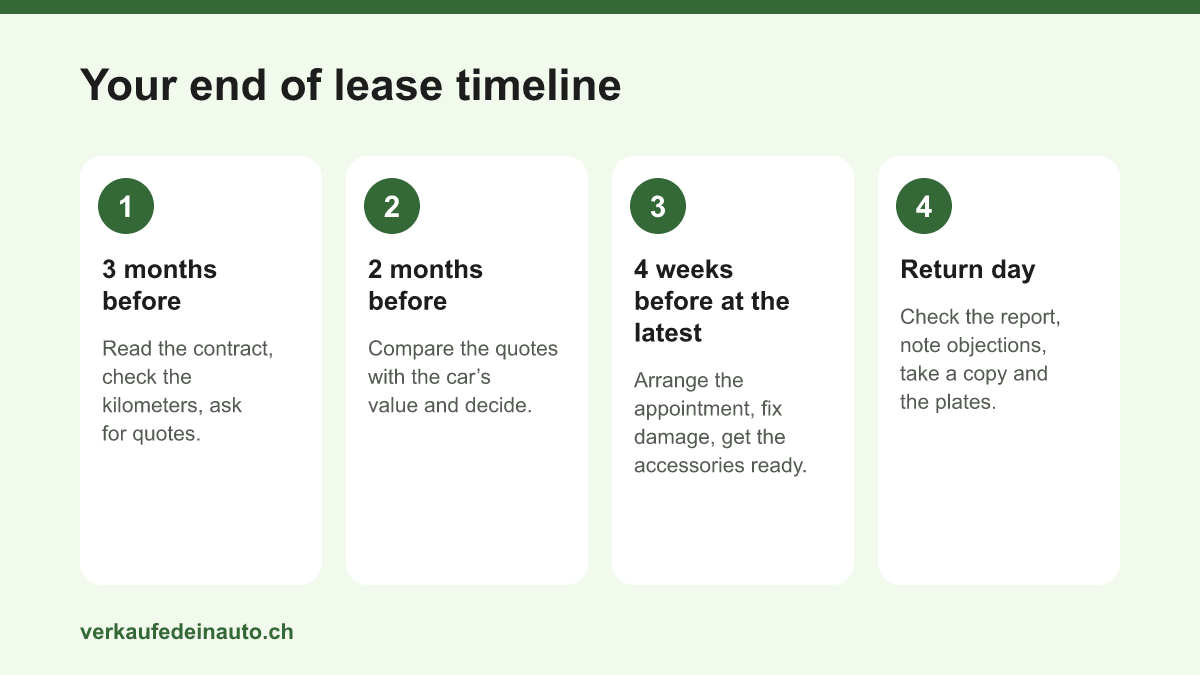
Your end of lease timeline
An example: if your lease ends at the end of June, contact the garage at the end of March and arrange the return appointment by the end of May at the latest.
- Three months before: read the contract and terms, compare the mileage with the agreed mileage allowance, ask the garage or the leasing company for a purchase quote and about an extension.
- Two months before: compare the written quotes with the current value of the car and decide.
- Four weeks before at the latest: arrange the return appointment, have damage repaired, gather the accessories.
- On the day of the return: check the report, record your objections, take a copy and the license plates with you.
- Afterward: compare the final statement with the report, ask for any security deposit back and cancel the standing order for the lease payments.
The license plates are assigned to you, not to the car: you take them with you at the return. If you don’t register another car, you must return them to the road traffic office (Strassenverkehrsamt) or deposit them there. You’ll find the deadline and costs in the guide Deregistering your car, and what applies to your policy in the guide Canceling your car insurance.
Want to know what your leased car is worth today before you decide? Request a free offer and compare it with the residual value and the purchase quote.
This guide provides general information and is not legal advice. Your contract and its terms are what count.
Frequently asked questions
Can I simply keep my leased car at the end?
No. The car belongs to the leasing company, and without a new agreement you have to return it on the last day of the contract. You can only keep it if you buy it or extend the contract, and both require the consent of the garage or the leasing company. So ask in writing for a purchase quote or an extension offer about three months before the lease ends.
What does it cost to return a leased car?
You can be charged for excess kilometers at the rate in the contract, repairs for damage beyond normal wear and tear, missing accessories and outstanding fees. Any security deposit is offset against these, and you get the rest back. Ask for a breakdown of all items and compare it with the return report.
When do I need to get in touch before my lease ends?
The TCS recommends contacting the leasing company about three months before the lease expires. You arrange the return appointment a few weeks before; AMAG Leasing requires at least four weeks. If you want to extend or buy the car, you need more lead time for quotes and the check of your creditworthiness.
Do I get money back if I drove fewer kilometers?
No. The terms of AMAG Leasing and Santander Consumer Finance state explicitly that excess kilometers are charged, but that there is no refund for kilometers not driven. The agreed mileage is the basis for your lease payment, not a credit balance. With an extension or a new contract, you can agree on a lower mileage, which usually lowers the payment.
What do I do if I don’t agree with the return report?
Only sign once you have read everything, and note your objections directly on the report before you sign. Ask for a copy and a breakdown of the costs. Otherwise, with AMAG Leasing, your only option is a registered letter within five days. If you still can’t agree, these terms let you request a neutral assessment that is binding on both sides; the costs are split depending on the outcome.
Sources
- Consumer Credit Act (KKG), Art. 7, 11, 17 and 29 – Fedlex (in German)
- Swiss Leasing Association (SLV): Wear and tear standards for returning leased vehicles (in German)
- TCS: When a lease agreement expires – tips for returning a leased car (in German)
- AMAG Leasing: General leasing terms, edition 01/26 (PDF) (in German)
- Santander Consumer Finance Switzerland: General terms and conditions for leasing (PDF) (in German)
- Cembra: Application form for a contract extension (PDF) (in German)