Selling a car without MFK: is it possible, and what does it mean for the price?
You’re allowed to sell a car whose MFK (vehicle inspection) is due or overdue. What buyers need to register it, how the price reacts and which options are open to you.

In short
- Selling a car with a due MFK is allowed; concealing defects is not.
- Passenger cars: first MFK after five years, then after three, then every two years.
- Whether the buyer needs an inspection before registering depends on their canton.
Your MFK (vehicle inspection) is coming up, the inspection notice may already be in your mailbox, and you don’t really want to keep the car anymore. Are you allowed to sell a car without MFK? Yes. In Switzerland, a freshly passed vehicle inspection is not a requirement for selling a car; it is a selling point.
Still, the missing inspection changes the sale: it determines who might buy the car, what they pay and what they have to take care of afterward. The examples come from Zurich, Bern and Aargau; the fees are as of September 2026. This guide provides general information and is not legal advice.
What the law says when you sell a car without MFK
The periodic inspection is tied to the registration, not to the sale. Vehicles registered with license plates are inspected, and the road traffic office (Strassenverkehrsamt) calls the registered keeper in for it (Art. 33 VTS). There is no rule saying that only inspected cars may be sold. The sale itself is governed by sales law. This results in two duties:
- Don’t conceal defects. If you know about defects, for example from an inspection report that lists faults, they belong in the sales contract. Even if you exclude liability for defects (the warranty), you are still liable for defects you knowingly conceal.
- Don’t promise anything that isn’t true. Write the date of the last inspection in the contract, and don’t sell the car “ab MFK”, that is, with a freshly passed inspection, if that inspection is still pending.
Strictly speaking, an MFK doesn’t expire; it becomes due. “Without MFK” can therefore mean three things: the inspection will soon be due, the notice has already arrived, or the car failed the inspection. Tell the buyer which case applies.
When the MFK is due
For passenger cars and motorcycles, the first inspection is due five years after first registration, but no later than after six years; the next one after three years, and after that every two years (Art. 33 para. 2 VTS).
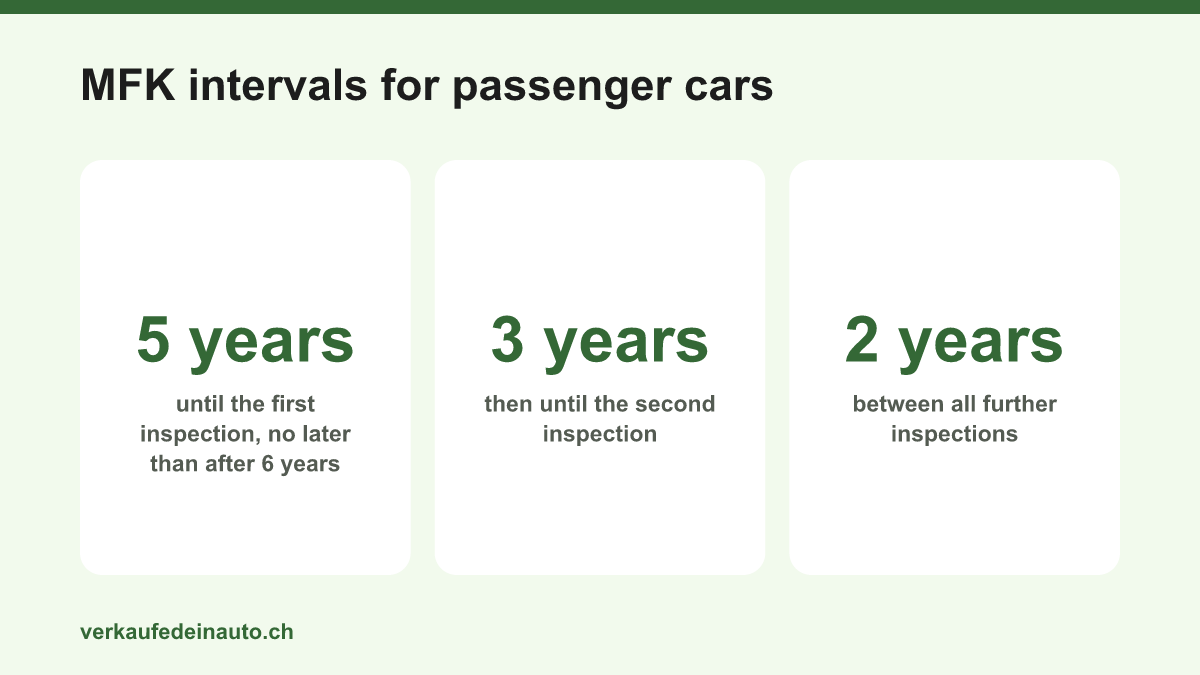
The date of your car’s last inspection is shown in the vehicle registration document (Fahrzeugausweis). For you as the registered keeper, what counts is the notice from the road traffic office, not the calendar: if it arrives later than the interval says, you haven’t missed anything. For the sale, the date still matters because the buyer’s canton goes by it. You can also have the car inspected voluntarily at any time (Art. 33 para. 3 VTS).
Until the sale, you may keep driving a registered, roadworthy car; test drives remain possible. If you need a little more time to sell, the inspection appointment can be postponed to some extent; in Zurich, for example, you can do this online. Simply ignoring a notice is not a solution: the office will then withdraw the vehicle registration document and the license plates (Art. 106 VZV).
What is your car worth?
Get a free offer without obligation in a few minutes.
What the buyer needs to register the car
To register the car in their name, the buyer needs the original of the previous vehicle registration document and proof of insurance (Art. 74 VZV). Whether the office first requires an inspection varies from canton to canton:
- Zurich: Cars that are 15 years old or older are only registered after an inspection, unless the last one was less than two years ago.
- Aargau: A car is only registered if the time since its last inspection does not exceed the inspection interval and no road traffic office has blocked the car.
What counts is the buyer’s canton. A twelve-year-old car that was last inspected three years ago does not fall under the 15-year rule in Zurich. In Aargau, the last inspection lies outside the two-year interval; there, the car is only registered after it has passed the MFK.
If the office requires an inspection first, the question is how the car gets there: after the sale, it is deregistered, no longer has plates and, as a rule, may not be driven on the road like that. Depending on the canton, the buyer needs a one-day permit, an authorization to drive directly to the inspection, or a way to transport the car. All of this means effort and risk, and that is exactly what the buyer factors into the offer. The guide Change of ownership of a car shows the whole process.
What the missing MFK means for the price
There is no fixed discount. The buyer takes three items into account: the repairs that might be needed to pass the inspection, their own effort and a reserve for the unknown. The older the car and the less clear its condition, the bigger this reserve.
For a newer, well-maintained car with a complete service booklet, an upcoming inspection carries little weight. For a fifteen-year-old car with rust on the underbody, it often makes or breaks the sale. Private buyers often search specifically for “frisch ab MFK” (with a freshly passed MFK). Dealers and exporters calculate differently because they do repairs themselves or don’t register the car in Switzerland at all anymore. What else affects the price is explained in the guide What determines the value of a used car.
Get the MFK done first or sell as is? Three options compared
Whether it pays to have the inspection done beforehand depends on the car and on your time. This is how the three options differ:
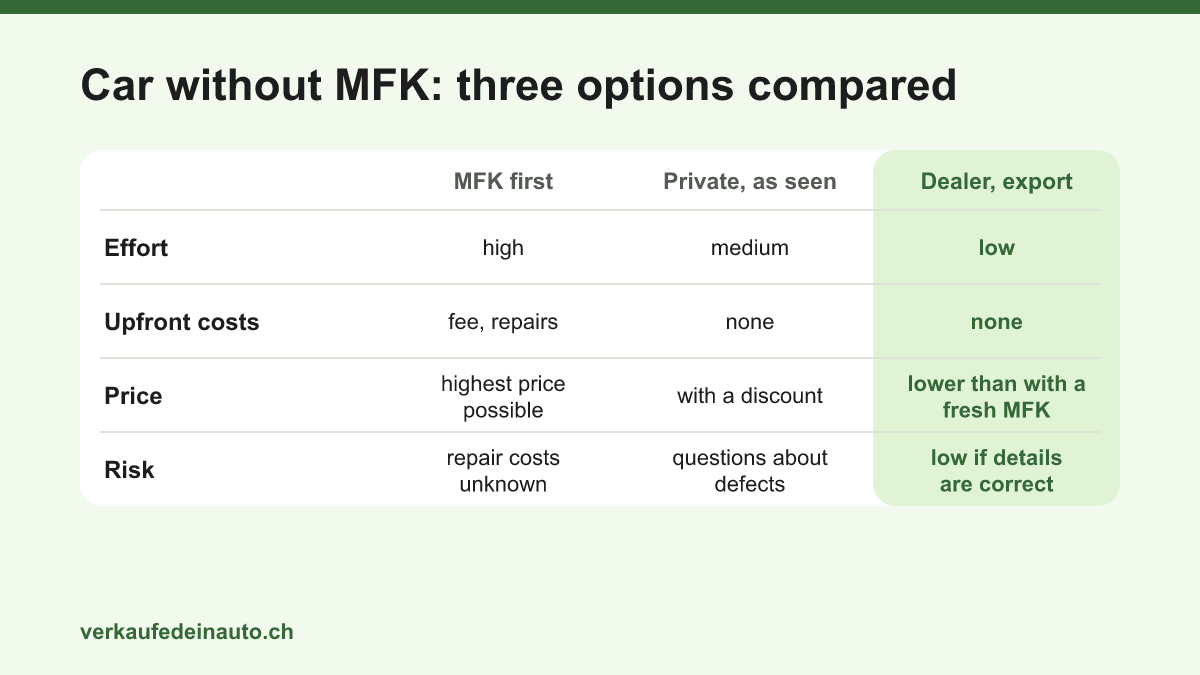
Getting the MFK done before the sale
You book the car in for an inspection voluntarily or keep the appointment from your notice; in Zurich, the TCS also carries out the inspection. The checks include brakes, steering, lights, suspension, tires and exhaust emissions. Plan for the following items, taking the canton of Bern as an example:
| Item | What it costs |
|---|---|
| Inspection fee | CHF 60 for a passenger car |
| Re-inspection after faults were found | CHF 30 if no new inspection is needed; within 30 days |
| Preparation and repairs | depends on the car, unknown in advance |
Having the inspection done beforehand pays off if the extra you get for the car clearly exceeds the costs. A worked example with assumed, round figures: if the garage estimates the work at CHF 1’200 and the inspection costs CHF 60, the car must fetch at least CHF 1’260 more with a fresh MFK than without. If it fetches less, you lose money.
The risk: if the inspector finds more faults than expected, you need to repair them and present the car again, or you sell it with an inspection report that lists the defects in black and white. These defects are then known and belong in the sales contract.
Selling privately “ab Platz” (sold as seen)
You sell the car as it stands, without an inspection, and exclude the warranty. This works mainly with buyers who work on cars themselves or have a garage they can turn to. List all known defects in the contract and write the exclusion as a full sentence instead of relying on the two words “ab Platz”. You’ll find suitable wording in the guide on the car sales contract.
Selling to a dealer or for export
Dealers and car buying companies also buy cars whose MFK is due or overdue. The price is usually below what would be possible privately with a fresh inspection; in return, there is no upfront outlay and no risk. verkaufedeinauto.ch also buys such cars: in the form, you state when the last inspection was and what you know about the car’s condition, and you then receive a firm offer.
For older cars with high mileage or defects whose repair no longer pays off here, export is often the way to go. The car then no longer has to be registered to a new keeper in Switzerland. If the car is loaded for transport, the MFK plays no role. If it is to be driven across the border with export plates, it must be roadworthy: for cars over ten years old with an overdue inspection, the canton of Bern requires a confirmation from a recognized garage or an export inspection.
Not sure which option pays off? Get a free, non-binding offer and compare it with the price you expect with a fresh MFK, minus the inspection and repairs.
Frequently asked questions
Can I still drive a car with an expired MFK?
Yes, as long as the car is roadworthy and you haven’t missed a notice. An MFK doesn’t expire like a motorway vignette: the vehicle registration document remains valid even if the last inspection was some time ago, and the road traffic office calls you in for the next one. Only if you fail to comply with a notice without good reason does the office withdraw the vehicle registration document and the license plates (Art. 106 VZV).
How long is an MFK valid when you sell a car?
There is no fixed validity period for a sale. A passed inspection counts until the next periodic inspection, which means two years for older passenger cars. For registration in the buyer’s name, the buyer’s canton is what matters: Zurich, for example, registers cars that are 15 years old or older without a new inspection if the last one was less than two years ago. The more recent the inspection, the longer the buyer has peace of mind.
Who pays for the MFK if I sell the car without an inspection?
Unless agreed otherwise, the buyer, because they want to register the car in their name. You and the buyer can agree on something different in the sales contract. If you sell “ab MFK” (with a freshly passed MFK), you present the car for inspection before the handover and pay the fee and any necessary repairs. If you sell “ab Platz” (sold as seen), the buyer takes on both and pays less for the car in return. Put in writing which option applies.
Can I deregister the car instead of taking it to the MFK?
Yes. Only vehicles registered with license plates are subject to the periodic inspection (Art. 33 VTS). If you hand in the plates and have the vehicle registration document canceled, the inspection no longer applies for the time being. It becomes an issue again when someone wants to register the car, and then under the rules of the new registered keeper’s canton. Deregister the car in good time before the inspection appointment so that no fee is charged for the appointment.
Can I sell a car that failed the MFK?
Yes, but with your cards on the table. The faults listed in the inspection report are known defects and belong in the sales contract; ideally, give the buyer the report. There is a deadline for the re-inspection: 30 days in Bern. If you don’t have the defects fixed, deregister the car before the deadline expires. The buyer must then expect to have it inspected before it can be registered: in Aargau, for example, a car that a road traffic office has blocked is not registered.
Is it worth getting the MFK done on an old car before selling it?
Only if the repairs cost clearly less than the extra the car fetches with a fresh MFK. Have a garage estimate what would need to be done to pass the inspection. With old, high-mileage cars, the repairs can exceed the extra you would get. Then selling without an inspection is usually the more sensible route: privately “ab Platz”, to a dealer or for export.
Sources
- Ordinance on the Technical Requirements for Road Vehicles (VTS, SR 741.41), Art. 33 (in German)
- Road Traffic Licensing Ordinance (VZV, SR 741.51), Art. 74 and 106 (in German)
- Canton of Zurich, Road Traffic Office: Vehicle inspection (in German)
- Canton of Aargau, Road Traffic Office: Inspection intervals and registration rules (in German)
- Canton of Bern, Road Traffic and Navigation Office: Notes on the vehicle inspection (in German)
- Canton of Bern, Road Traffic and Navigation Office: Exporting a vehicle (in German)