Right of first refusal and profit sharing on a lease: what the contract says
Can you buy your leased car at the residual value, and who gets any extra value? What the law and lease terms say about the purchase option, the right of first refusal and profit sharing.

In short
- The law gives you no right to buy your leased car at the end of the lease.
- AMAG Leasing, for example: no right to acquire the car, residual value for information only.
- AMAG Leasing’s terms do not provide for a share in any surplus.
Can you buy your leased car at the residual value when the lease ends? And do you get a share if it is worth more than calculated? In Switzerland, a right of first refusal on a lease or profit sharing only exists if the contract says so, and the terms and conditions we have read say something different. Here you can read what the law covers, what leasing companies write and how to find the decisive clause in your contract.
Purchase option, right of first refusal, profit sharing: three different things
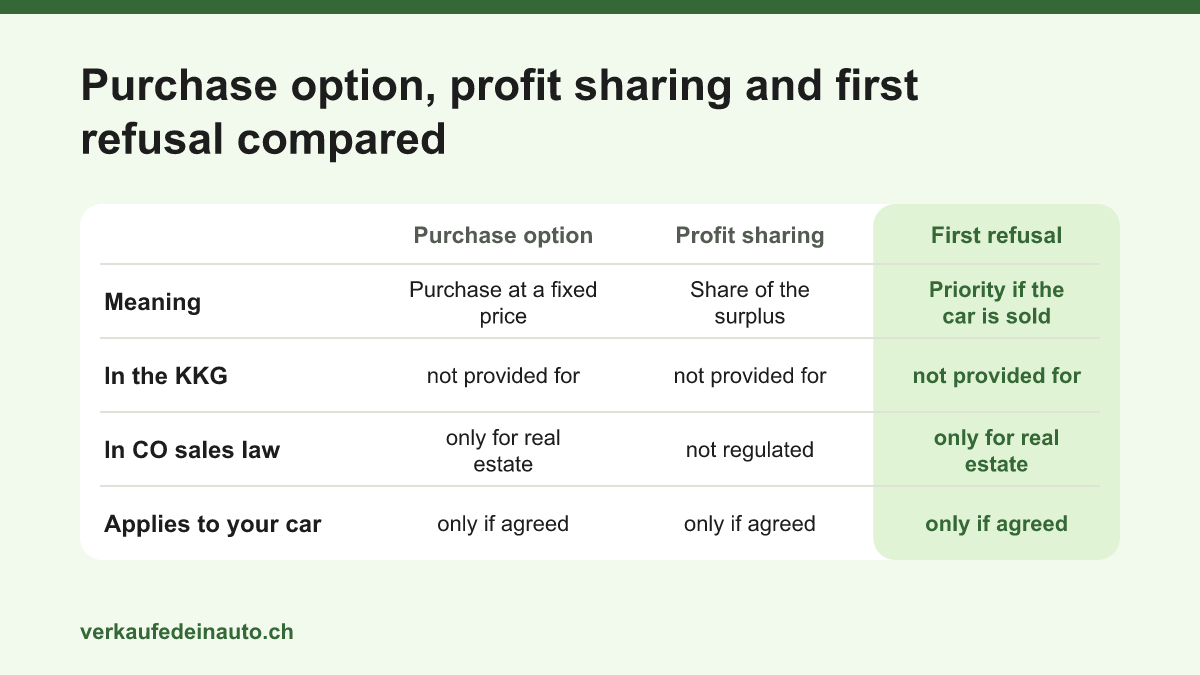
- Purchase option (Kaufsrecht): You may buy the car at a price fixed in advance if you want to. The owner must then sell.
- Right of first refusal: You get priority if the owner sells the car. The owner decides whether to sell, and the price depends on what was agreed; it is not automatically the residual value. The term is also often used for the right to take over the car at the end. Strictly speaking, that would be a purchase option.
- Profit sharing (a share in the surplus): You receive a share if the car fetches more than the residual value at the end.
What the law covers – and what it doesn’t
Consumer Credit Act (KKG)
The KKG generally applies to private leasing. It covers lease agreements for movable goods for private use if the installments are increased when the contract is terminated early (Art. 1 para. 2 let. a), and it does not apply to credit below CHF 500 or above CHF 80’000 (Art. 7 para. 1 let. e). Among other things, it prescribes the following for these contracts:
- Form and content (Art. 11): a written contract with the cash purchase price, installments, deposit, effective annual interest rate and a table showing the additional payment and the residual value in the event of early termination.
- Withdrawal (Art. 16): in writing within 14 days after you have received your copy of the contract.
- Early termination (Art. 17 para. 3): with at least 30 days’ notice to the end of a three-month lease period; the compensation is based on the table.
These rules cannot be changed to your disadvantage (Art. 37). What the KKG does not contain: a right to buy the car, and a rule on who is entitled to any extra value. The law gives you a right to terminate, but no right to buy.
Code of Obligations (CO)
The CO has no chapter of its own on lease agreements. Freedom of contract applies: the terms of a contract may be freely determined within the limits of the law (Art. 19 CO). In its sales law, the CO regulates rights of first refusal and purchase options only for real estate (Art. 216 ff.). For a car, they only exist if the parties have agreed on them. This also applies to lease agreements outside the KKG, for example for company cars.
What leasing companies write about it
We have read published terms and conditions and information from leasing companies in Switzerland and from their association:
| Source | What it says about buying |
|---|---|
| AMAG Leasing, terms 01/26 | no right to acquire the car; residual value for information only |
| Cembra, customer center | return to the supplier, who sets the price anew |
| BANK-now, questions and answers | return, or purchase by paying the residual value |
| Swiss Leasing Association | acquisition only by mutual agreement |
Under AMAG Leasing’s terms (section 1.3), the vehicle remains the exclusive property of the lessor even after the end of the lease, and the lessee must return it. This does not rule out a purchase, but it gives you no right to one. If you want to acquire a vehicle as your property and keep it after the end of the contract, the Leasing Association’s overview does not count this as leasing, but as an installment contract or a loan tied to the vehicle (Objektkredit).
The information differs: BANK-now names buying the car by paying the residual value as an option, while Cembra refers you to the supplier, who sets the price anew. What counts, therefore, is your own contract with the terms and conditions you received with it.
What is your car worth?
Get a free offer without obligation in a few minutes.
Right of first refusal in leasing: who comes first when the contract ends
The right of first refusal is a legal term, but there is no statutory right of first refusal for lessees, and AMAG Leasing’s terms do not contain a contractual one either. According to Cembra’s description, the car usually goes to the supplying garage at the end, called the supplier in the contract. The garage takes it over at the return value agreed in the contract, and it is up to the garage to sell it and set the price anew.
If the salesperson promises you when you sign that you can buy the car at the residual value later, this is initially a commitment by the garage. The leasing company is only bound by it if it has agreed in writing: under AMAG Leasing’s terms, oral side agreements are invalid, and special agreements require the lessor’s written consent.
Tip
Get any commitment that you can buy the car in writing before you sign: with the price, the date and the name of the company making it. Have the leasing company confirm it in writing as well.
Profit sharing in leasing: who gets the extra value?
In leasing, profit sharing is not a legal term: the KKG does not use the word, and the CO only uses it in company law. If your car is worth more than the residual value at the end, the leasing company benefits, or the garage that takes it over at the agreed value. AMAG Leasing’s terms contain no clause that gives you a share in the surplus at the regular end of the lease.
Conversely, they also contain no clause under which you pay extra at the regular end of the lease just because market prices have fallen in general. Under these terms, you are charged for excess kilometers and for repairs that are not due to normal wear and tear or that are needed for operational safety. Added to this is a loss in value after an accident, to the extent that the insurance does not cover it, or if servicing and bodywork were not carried out by an official brand partner.
These terms only provide for a difference in your favor arising from the car’s value in the event of a claim. In the case of a total loss or theft, the settlement is based on the current calculated residual value: you pay what the insurance does not cover; if its benefits exceed the book value and any further loss suffered by the lessor, you are entitled to the difference.
If you want to benefit from any extra value yourself, you have two options. You buy the car if you are offered a price below its market value; how to check this is explained in the guide on lease buyouts. Or you have the contract settled before it ends: a buyer pays the settlement amount calculated by the leasing company directly to the company and transfers the difference to you. This requires the leasing company’s consent; you cannot sell a car that belongs to it yourself. It pays off if the buyer pays more than the settlement amount and fees combined. What influences the price is explained in the guide What determines the value of a used car.
How to find the clause in your contract
Lay the contract, the general terms and conditions and all supplementary sheets side by side and look for these specific points:
- First page: cash purchase price, residual value at the end of the lease, agreed kilometers and the rate per excess kilometer.
- Contract content and ownership (section 1 in the AMAG Leasing terms): whether you have a right to acquire the car and what the residual value means.
- Return: date, return report and liability for damage.
- Early termination table: additional payment and residual value depending on the date.
- Special agreements: individual additions such as a commitment that you can buy the car, and the rule that side agreements must be in writing.
In a PDF, it helps to search for the words “acquire” (erwerben), “ownership” (Eigentum), “residual value” (Restwert) and “return” (Rückgabe). If you find nothing about a purchase, you have no contractual right to one. You can still ask.
What you should clarify in writing before the lease ends
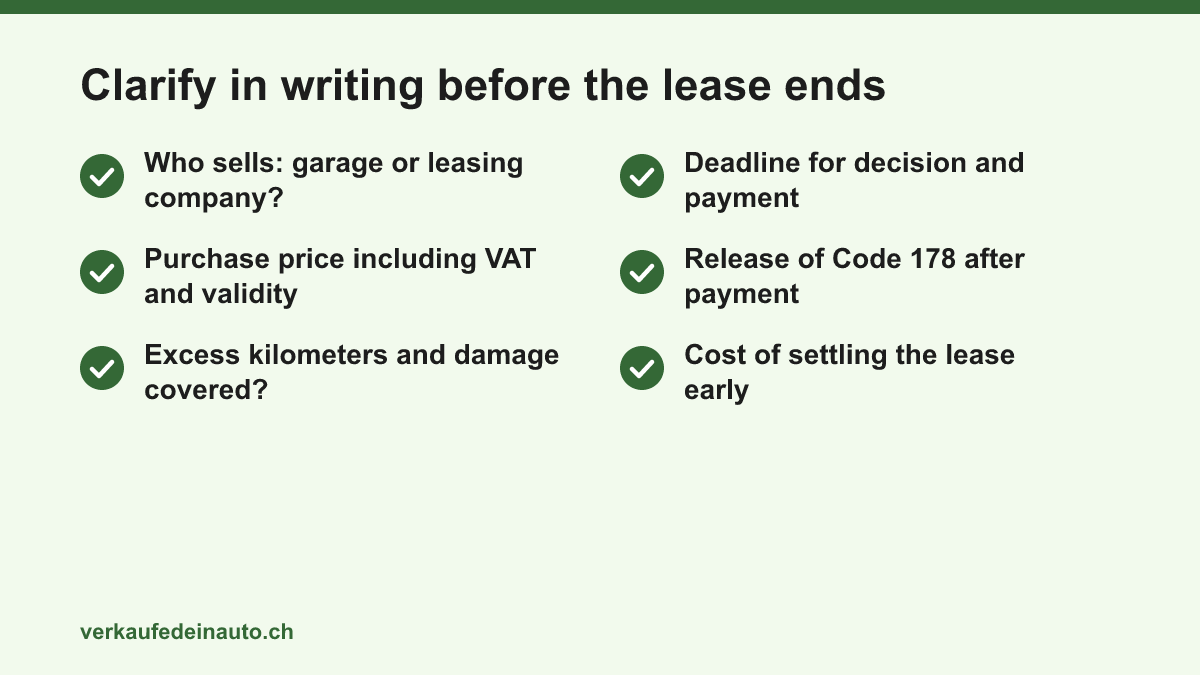
About three months before the end, send the garage and the leasing company an email and ask for written answers:
- Can I buy the car at the end of the lease, and who sells it: the garage or the leasing company?
- At what price including VAT, and until when is the offer valid?
- Does this cover excess kilometers, damage and fees?
- By when do I have to decide and pay?
- When will the entry “change of ownership prohibited” (Code 178) in the vehicle registration document (Fahrzeugausweis) be released?
- What does it cost to settle the contract early on a specific date?
With the answers, you can compare at your leisure: return the car, buy it or have the lease settled. How the return works is shown in the guide on the end of the lease. If you want to know what a car buyer pays for your leased car, verkaufedeinauto.ch makes you a firm offer based on your information and photos and handles the settlement with the leasing company; the page Selling a leased car shows how it works. Request your free offer here.
This guide provides general information and is not legal advice. The wording of your contract is what counts; in a dispute, legal advice or your legal protection insurance can help.
Frequently asked questions
Do I have a right of first refusal on my leased car?
Not by law. Neither the Consumer Credit Act nor the Code of Obligations gives lessees a right to buy the car. A right of first refusal or a purchase option only exists if it is set out in your contract or in a written supplementary agreement. AMAG Leasing’s terms, for example, expressly state that the lessee has no right to acquire the car. You can still buy the car if the garage or the leasing company agrees.
What does the residual value in the lease agreement mean?
The residual value is the calculated value of the car at the end of the lease term. It is set when the contract is signed and, together with the purchase price, lease term, kilometers and interest, determines the amount of the installments. It does not give you a right to buy the car for this amount: under AMAG Leasing’s terms, for example, it is stated in the contract expressly for information only. Whether the car is sold, and at what price, is decided by the garage or the leasing company.
Is there profit sharing on a lease in Switzerland?
There is no statutory profit sharing, and AMAG Leasing’s terms do not provide for any at the regular end of the lease either. If you return the car, any extra value stays with the leasing company or the garage. You can only benefit from it if you can buy the car at a good price, or if the leasing company agrees that a buyer settles the contract early and pays you the difference above the settlement amount.
Is an oral promise from the salesperson that I can buy the car valid?
Contracts are valid without any special form where the law does not prescribe one (Art. 11 CO). However, an oral promise binds at most the company that made it, and it is hard to prove. It won’t help you with the leasing company: AMAG Leasing’s terms, for example, declare oral side agreements invalid. So ask for a written confirmation with the price and date, ideally from both the garage and the leasing company.
Can I buy out my leased car before the end of the lease?
That is possible if the leasing company agrees. The Consumer Credit Act gives you the right to terminate the contract with at least 30 days’ notice to the end of a three-month lease period; the additional payment is based on the table in the contract. To buy the car, you also need an offer; the leasing company often refers you to the supplying garage for this. Ask beforehand whether the calculation costs anything.
Sources
- Consumer Credit Act (KKG), Art. 1, 7, 11, 16, 17 and 37 (in German)
- Code of Obligations (CO, SR 220), Art. 11, 19 and 216 ff.
- Swiss Leasing Association (SLV): Financing models for vehicles (in German)
- AMAG Leasing: General leasing terms (PDF), edition 01/26 (in German)
- Cembra: Leasing for private individuals – What happens after my lease agreement has expired?
- BANK-now: Questions and answers on leasing and financing (in German)