Car sales contract: what it should say and what applies in Switzerland
In Switzerland, a car sale is valid even on a handshake. Why you should put it in writing and what belongs in the sales contract: payment, handover, defects, warranty.

In short
- A car sale is valid even if agreed orally, but in writing you can prove it.
- You can exclude the warranty, except for defects that were fraudulently concealed.
- State in the contract that the risk only passes to the buyer at the handover.
If you type “car sales contract” into a search engine, you usually want a template fast. You’ll find out where to get one further down. It’s more important to know what the contract should say, and why. In Switzerland, a car sale is valid even if it is only agreed orally. That is exactly why a properly drafted contract is worth it: it records what was sold, in what condition, at what price and from when the car is no longer your risk.
This guide also explains the warranty, that is, your liability for defects, and shows what to watch out for when a dealer is the buyer. It provides general information and is not legal advice.
Is a written sales contract mandatory when you sell a car?
No. Contracts only require a special form if the law prescribes one (Art. 11 CO), and it prescribes none for buying a car. A purchase agreed orally is valid and binding. The law does not provide a general right to change your mind afterward.
You should still put it in writing, for three reasons:
- Proof: In a dispute, you must be able to show what was agreed. Without anything on paper, it’s your word against theirs.
- Condition: The contract records which defects the buyer knew about and what assurances you gave.
- Timing: If the driver is not stopped after an offense, for example at a radar speed check, the fine goes to the registered keeper (Art. 7 OBG), the person named in the vehicle registration document (Fahrzeugausweis). The date and time of the handover prove that the car was already with the buyer by then.
Print two copies and have both of you sign them; that way each side has an original.
What belongs in the sales contract: the checklist
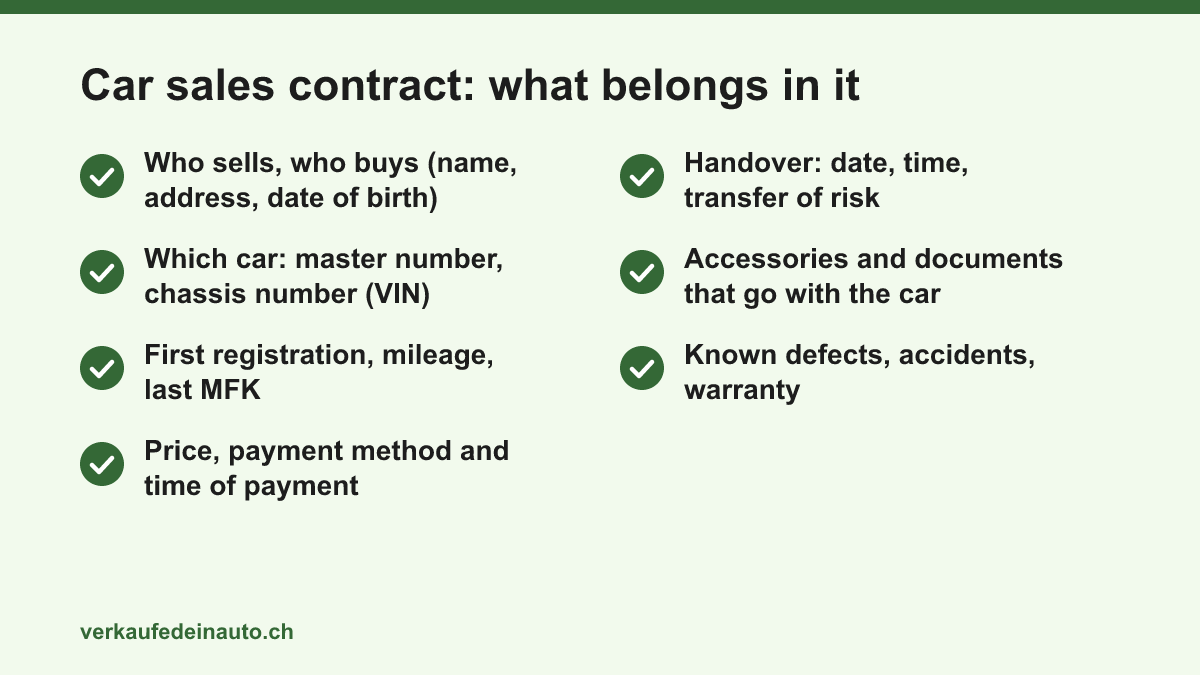
A good contract is short and covers seven points. The graphic gives an overview.
Parties and vehicle
The name, address and date of birth of the seller and the buyer go at the top; ask to see the buyer’s identity card or passport. As the seller, you confirm that the car belongs to you and that nobody else has a claim to it, such as a bank or a leasing company. A leased car belongs to the leasing company; how you can still sell it is explained under Selling a leased car.
Describe the car so that it cannot be mistaken for another one. Copy the details from the vehicle registration document and add the mileage:
- Make, model and color
- Master number (Stammnummer) and chassis number (VIN)
- Date of first registration
- Mileage at the handover
- Date of the last MFK (vehicle inspection)
Price and payment
The contract should state the purchase price in francs, the payment method and when payment is made. Unless agreed otherwise, both sides perform at the same time: the car in exchange for the money (Art. 184 para. 2 CO). Stick to that. If you let the car go before you are paid and the buyer then fails to pay, you can only demand it back if you expressly reserved that right (Art. 214 para. 3 CO).
With an instant bank transfer, you usually see the payment arrive in your own online banking within seconds. A screenshot on the buyer’s phone, on the other hand, proves nothing. How to protect yourself against fraud during payment and test drives is explained in the guide How selling a car in Switzerland works today.
What is your car worth?
Get a free offer without obligation in a few minutes.
Handover: timing, accessories and documents
When the risk passes to the buyer
A peculiarity of Swiss sales law: unless agreed otherwise, “benefit and risk” generally pass to the buyer as soon as the contract is concluded, not only at the handover (Art. 185 para. 1 CO). This means the risk that something happens to the car without anyone being at fault. If hail damages the car between signing and handover, the buyer would still have to pay the full price under this rule. Hardly anyone accepts that, and the law allows exceptions. So state in the contract that the risk only passes at the handover.
Wording
Write in the contract: “Benefit and risk pass to the buyer upon handover of the vehicle on … at … o’clock.” Fill in the date, time and mileage by hand at the handover.
Accessories and documents
List what comes with the car: number of keys, second set of wheels, roof rack, charging cable. And which documents you hand over: vehicle registration document (canceled if the buyer is a private person), service booklet, invoices, report of the last MFK. That way you won’t argue later about whether the winter wheels were included.
Defects, accident damage and warranty
What you know belongs in the contract
Write down what you know about: the stone chip in the windshield, the air conditioning that no longer cools, the repaired rear-end damage. This protects you in two ways. You are not liable for defects the buyer knew about at the time of purchase (Art. 200 CO). And nobody can accuse you later of having concealed something.
Even as a private seller, you must disclose accident damage, except for trivial things such as minor paint or bodywork damage. State whether the car is accident-free and, if not, what was damaged and how it was repaired. Only promise in the contract what you know for sure: you are liable for such assurances, for example “accident-free”. If you bought the car used yourself, “accident-free as far as the seller is aware” is the right wording.
Warranty: what applies and how to exclude it
If the contract says nothing about it, you are liable by law for defects that eliminate or considerably reduce the value or usability of the car. This also applies to defects you knew nothing about (Art. 197 CO). The buyer can then undo the purchase or demand a price reduction. However, the buyer must inspect the car and report defects immediately, and hidden defects immediately after discovering them. The buyer’s claims expire two years after the handover (Art. 210 CO).
Because this liability goes a long way, private sellers usually exclude it (in legal German: “wegbedingen”). This is allowed, but it has limits: the exclusion does not apply to defects you fraudulently concealed, that is, against your better knowledge (Art. 199 CO). And it usually does not cover what you expressly assured. There is also a middle way: you exclude the statutory liability and give a limited guarantee instead.
| The contract says | What applies |
|---|---|
| nothing about the warranty | statutory liability for defects, two years |
| warranty excluded | no liability, except for fraudulent concealment and for assurances |
| exclusion plus guarantee (e.g., 3 months) | liability only to the agreed extent |
A possible wording: “The vehicle is sold as viewed and test-driven. Any warranty is excluded to the extent permitted by law.”
“Ab Platz” and “ab MFK”: two phrases that are often misunderstood
“Ab Platz” means the car is sold as seen: as it stands, with the defects the buyer sees, or should see, during the viewing. Whether these two words also cover hidden defects is not clear-cut. So write the exclusion as a full sentence.
“Ab MFK” means the car is handed over with a freshly passed MFK. If you promise this, you have to present the car for inspection and have any faults found fixed. The phrase says nothing more; it is not a guarantee for the engine or transmission. If the inspection is still pending, read on in the guide MFK when selling a car.
When a dealer buys: what to check in the purchase contract
If a garage, a dealer or an online car buyer is buying, the contract usually comes from their side. Legally, the same rules apply as between private individuals. Four points deserve a second look:
- Your information: Forms ask whether the car is accident-free, its mileage and any previous damage. Whatever you check and sign counts as an assurance from you. Answer precisely and add a note by hand if a field doesn’t fit.
- Price: Check whether the amount is firm or whether the dealer may still lower it after inspecting the car later.
- Warranty: You can exclude it with a dealer too. Here, too, you remain liable for fraudulently concealed defects.
- Deregistration: If the buyer takes care of deregistering the car at the road traffic office (Strassenverkehrsamt), put this in the contract with a deadline. What happens to the license plates, tax and insurance is explained under Deregistering your car after the sale.
At verkaufedeinauto.ch, the offer is based on your information and photos and is not renegotiated at the handover, provided your information is accurate. Payment is made at the handover by instant bank transfer, and the deregistration is included.
Car sales contract: where to get a template
You don’t have to draft the contract yourself. The TCS lets you create a personalized car sales contract (in German) online for free. Other templates are fine too, as long as they cover the seven points of the checklist. Cross out what doesn’t apply and add by hand what is missing, especially regarding defects and accessories.
After signing, it’s the road traffic office’s turn. Who does what at this stage is shown in the guide Change of ownership of a car.
Would you rather skip the listing, the viewings and drafting a contract? Request a free, non-binding offer here and compare it with a private sale at your leisure.
Frequently asked questions
Is a car sale valid on a handshake or via WhatsApp?
Yes. As soon as you agree on the car and the price, the contract is concluded, whether by handshake, on the phone or by message. A chat history does prove the agreement, but it settles neither the condition nor the warranty nor the handover. So record the sale in a contract that both sides sign.
Can the buyer withdraw from the contract after buying the car?
As a rule, no. There is no general right of withdrawal when buying a car, neither for the buyer nor for you. Exceptions apply if you agreed on a right of withdrawal in the contract, if the car has a defect for which you are liable, or if the buyer was intentionally deceived. In the case of deception, the buyer can challenge the contract within one year of discovering it (Art. 28 and 31 CO).
How long am I liable for defects after selling a car?
If the contract doesn’t cover it, for two years from the handover (Art. 210 CO), for defects the car already had when it was sold. If you have validly excluded the warranty, you are generally no longer liable. The exception is defects you knew about and fraudulently concealed: neither the exclusion nor the two-year period applies to them. The TCS legal platform lex4you states a liability of ten years for these.
What does “as viewed and test-driven” mean?
The phrase makes clear that the buyer has seen and driven the car and accepts it in this condition. You are not liable for defects the buyer noticed in the process; for defects the buyer should have noticed with ordinary care, you are only liable if you gave an assurance that they were not present (Art. 200 CO). For hidden defects, the phrase alone is not reliably enough. So add an express exclusion of any warranty.
Do you need a receipt when selling a car?
It isn’t mandatory, but it is strongly recommended for cash payments. Whoever pays is entitled to ask for a receipt (Art. 88 CO). The simplest option is a sentence in the sales contract: “Purchase price of CHF … received in cash today”, with the date and your signature on both copies. With a bank transfer, the payment arriving in your account is the proof. Wait for it before you hand over the car, keys and papers.
Sources
- Code of Obligations (CO, SR 220), in particular Art. 11 and 184–214
- Regulatory Fines Act (OBG, SR 314.1), Art. 7 (in German)
- TCS: Car sales contract, free template (in German)
- TCS: Buying a used car, the 10 biggest misconceptions (in German)
- TCS lex4you: What must a sales contract for a used car contain? (in German)
- TCS lex4you: Guarantees, “ab Platz” and “ab MFK” when buying a used car (in German)