Selling a financed car: how it works while the loan is still running
Personal loan, retention of title or Code 178? This determines whether you can sell right away, how you pay off the outstanding balance and what the buyer will want to see.

In short
- Personal loan: the car is yours and you may sell it; the loan continues.
- Retention of title or Code 178: you can only sell with the lender’s consent.
- You may repay consumer credit early, with no interest for the remaining term.
In Switzerland, you can almost always sell a financed car, but not always without the bank. It comes down to a single question: who owns the car today? With a personal loan, you do. With financing under retention of title or with leasing, someone else does, and then the sale requires their consent.
Here you can read how to classify your financing, what early repayment costs and how to proceed step by step up to the handover. This guide provides general information and is not legal or tax advice; your contract is what counts.
Before you sell a financed car: who owns it?
Three documents will help: the loan agreement, the vehicle registration document (Fahrzeugausweis) and, if in doubt, information from the debt collection office. The vehicle registration document only names the registered keeper, not the owner (Art. 78 VZV), but it does show any Code 178. There is no document in Switzerland like the German vehicle title (Fahrzeugbrief), which the bank keeps as security.
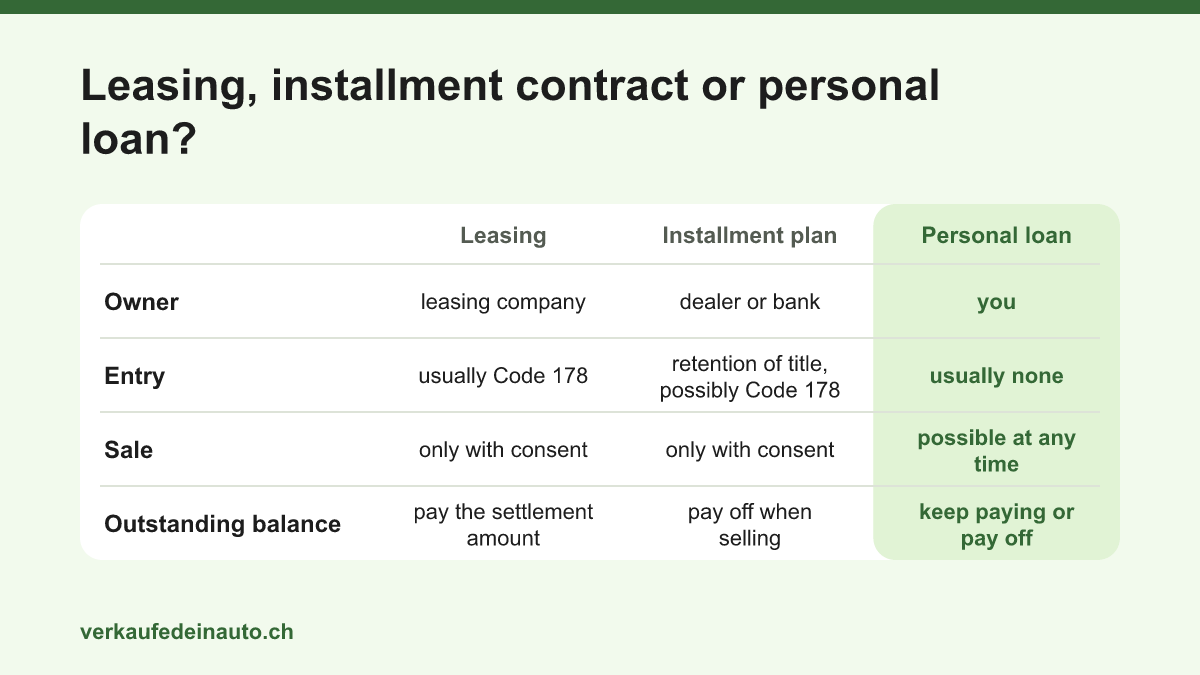
Personal loan: the car belongs to you
With a personal loan (called a cash loan in the law), the bank has nothing to do with the car, and ownership passes to you immediately; this is how the Swiss Leasing Association describes it. As a rule, there is therefore no entry at the debt collection office or in the vehicle registration document. You can sell the car at any time; BANK-now expressly states this for its car loan. The loan is your personal debt: it continues unchanged after the sale, or you repay it with the proceeds.
Installment contract: retention of title and Code 178
It is different with an installment contract (buying on installments) or a loan tied to the car (Objektkredit): these usually stipulate that ownership only passes to you with the last installment. The contract must state who owns the car until then (Art. 10 KKG). Legally, this is a retention of title. It is only effective if it is entered in the register of the debt collection office at your place of residence (Art. 715 CC). If there is no entry, you became the owner at the handover; however, the dealer can still have the entry made later, and you owe the debt under the contract in any case.
On top of this, there may be Code 178 “change of ownership prohibited” in the vehicle registration document. It blocks re-registration: the road traffic office (Strassenverkehrsamt) will not issue a registration document in the name of a new registered keeper until the beneficiary consents (Art. 80 and 81 VZV). It is known from leasing, but it is also used for loans: Appenzell Ausserrhoden expressly mentions installment purchases, and Aargau mentions financing as well as leasing.
Leasing: the car belongs to the leasing company
You cannot sell a leased car on your own authority. A sale is only possible if the leasing company agrees and names a settlement amount. Leased cars are also bought by verkaufedeinauto.ch, which handles the settlement with the leasing company; the page Selling a leased car shows how it works. What applies to termination and return is explained in the guide on the end of the lease.
What is your car worth?
Get a free offer without obligation in a few minutes.
Selling without consent: why it can be a criminal offense
If the car still legally belongs to the dealer, the bank or the leasing company, it has only been entrusted to you. Anyone who appropriates someone else’s property that has been entrusted to them, in order to unlawfully enrich themselves or others, commits misappropriation; this carries a custodial sentence of up to five years or a monetary penalty (Art. 138 SCC). The Federal Supreme Court has assessed the resale of a car under a registered retention of title in this way (BGE 82 IV 182), and courts have ruled the same way on the sale of leased cars. With a personal loan, the question does not arise, because the car belongs to you.
Repaying the loan early: what the law guarantees
For consumer credit of CHF 500 to CHF 80’000, the Consumer Credit Act (KKG) generally applies. It allows you to repay the loan early (Art. 17 para. 1 KKG). You then no longer owe interest for the remaining term, and the costs attributable to that period must be reduced appropriately (Art. 17 para. 2 KKG). This entitlement must be stated in the contract (Art. 9 KKG), and the contract may not deviate from it to your disadvantage (Art. 37 KKG).
Cembra, for example, writes that the financing can be repaid in full or in part at no additional cost. Ask in writing for the settlement amount, that is, the sum still outstanding on a specific date; it goes down with every installment. For larger loans and for company cars, what the contract says applies.
Outstanding balance versus car value: the calculation before the sale
A simple comparison shows whether the sale pays off: what will the car fetch today, and what does the lender require to settle the loan? You can estimate the market value with a free valuation and a look at listings of comparable cars. Two examples with assumed figures, both with an outstanding balance of CHF 12’000:
| Sale price | Calculation | Result |
|---|---|---|
| CHF 18’000 | 18’000 − 12’000 | you keep CHF 6’000 |
| CHF 10’000 | 10’000 − 12’000 | you are CHF 2’000 short |
If the car is worth less than the outstanding balance
Then you have three options. You pay the difference from your savings. You keep the car until the debt has fallen below its value. Or you sell and keep paying off the rest in installments; this only works with a personal loan, because there the car is not collateral. With a retention of title, the lender usually only releases the car once the entire debt has been paid. If money gets tight, talk to the lender or to a debt counseling service early on.
Having Code 178 and the retention of title removed
Only the beneficiary can release Code 178, which usually means the bank or leasing company that requested it. This is done electronically via the clearing office of the Central Office for Credit Information (ZEK); you ask the lender to do so.
The road traffic office then needs two things: the release and the original vehicle registration document, by mail or at the counter. The code is only removed once a new registration document has been issued; a canceled registration document with Code 178 remains blocked. If the car is registered directly in the buyer’s name, the canton of Bern, for example, removes the code together with the registration. Examples (as of September 2026):
| Canton | Fee | Processing time, note |
|---|---|---|
| Zurich | free | by mail within 5 business days, immediately at the counter |
| Bern | CHF 20 by mail, CHF 25 at the counter | if the registered keeper stays the same |
| Aargau | free | usually 1 to 2 business days |
Appenzell Ausserrhoden charges CHF 50 in addition to the fee for the new registration document. In Zurich, you can use the master number (Stammnummer) from the vehicle registration document to check online whether the code is still entered. If it was requested with the paper form, for example by a private individual, the same person must sign the original of the official removal form.
The debt collection office removes the retention of title at the request of the dealer or of the bank noted in the register. If you file the request yourself, you need the written consent of the entitled party. The removal is free of charge.
The order of steps: from the outstanding balance to the handover
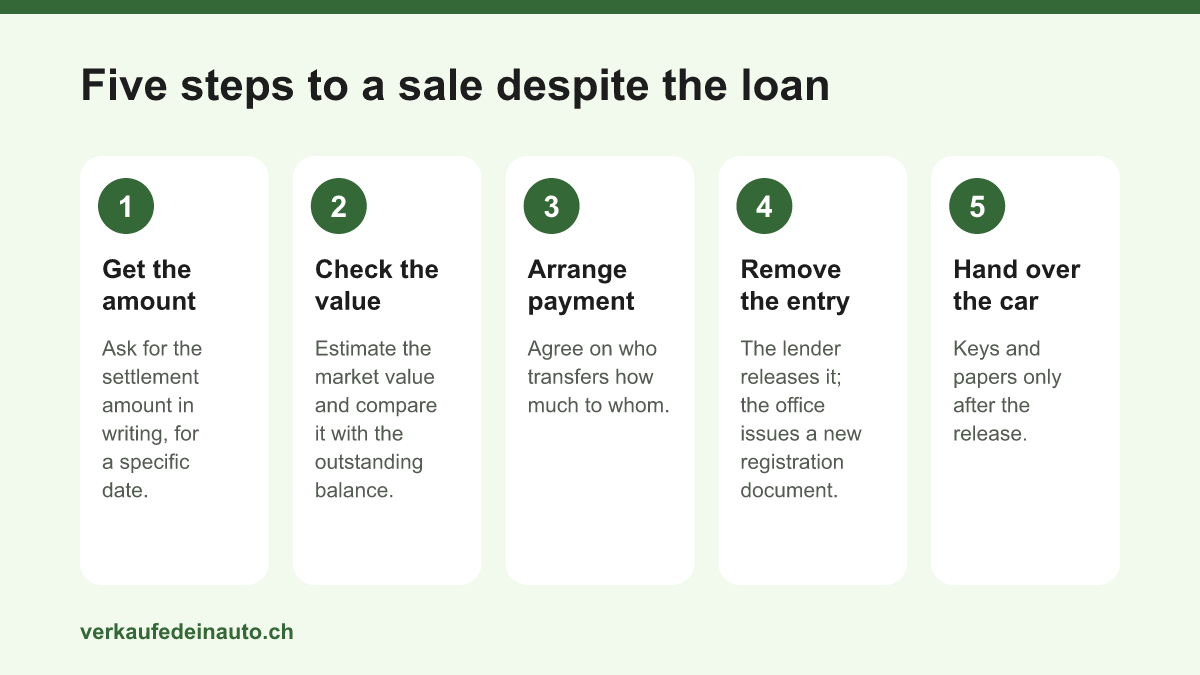
- Ask for the settlement amount. The lender tells you in writing what is outstanding on the desired date and where it must be paid.
- Check the value. If the price you can get does not cover the settlement amount, clarify beforehand where the missing amount will come from.
- Arrange the payment. It makes sense for the buyer to transfer the settlement amount directly to the lender and the rest to you.
- Have the entry removed. Once the payment has arrived, the lender releases Code 178 and has the retention of title removed; the road traffic office issues a registration document without the code.
- Hand over the car. Keys and papers change hands as soon as the release has been granted. Then comes the change of ownership.
Record in the sales contract who pays which amount to whom and that the handover only takes place after the release. With a personal loan, steps three and four do not apply: you sell the car like any other and then decide whether to pay off the loan.
Tip
Ask the lender for written confirmation that payment of the settlement amount discharges all claims and that the entry will be released. A copy belongs with the sales contract.
The documents a buyer will ask for
- the vehicle registration document without Code 178, or confirmation that the release has been granted
- the lender’s written confirmation with the settlement amount, date and account
- with a retention of title, confirmation of its removal or a certificate from the debt collection office stating that there is no entry in your name
The retention of title register is public. The buyer can also inquire at the debt collection office at your place of residence; an inquiry costs CHF 9, and a written extract or a certificate costs an additional CHF 8 per page (Art. 37 GebV SchKG). The Federal Supreme Court expects used car dealers to check the register before buying (BGE 113 II 397). As the seller, you are in any case liable to the buyer if a third party can take the car away from them on legal grounds (Art. 192 CO).
If the financed car comes from an inheritance, the rules for heirs also apply; you’ll find them in the guide Selling an inherited car.
If you want to sell your financed car, you can also offer it to verkaufedeinauto.ch. State the lender and the outstanding balance in your request; the next steps will then be agreed with you. If there is a retention of title or Code 178, the lender’s release is needed before the handover. The firm offer is based on your information and photos, and the online valuation is free and non-binding. Payment is made at the handover by instant bank transfer; the deregistration is included. Get your offer here.
Frequently asked questions
Can I sell a financed car while the loan is still running?
Yes, if the car belongs to you. That is the case with a personal loan: you sell it like any other car and keep paying off the loan or repay it early. If there is a retention of title or Code 178 is entered in the vehicle registration document, you first need the lender’s consent. The lender usually releases the car as soon as the outstanding balance has been paid.
How do I find out whether a retention of title is registered?
Check the contract first: if ownership does not pass to you immediately, it must name the owner. The debt collection office that keeps the register at your place of residence can tell you for certain; the register is public, and an inquiry costs CHF 9. If you have moved recently, ask at your previous place of residence as well: the entry remains effective there for another three months.
What does it cost to repay a car loan early?
If the loan is subject to the Consumer Credit Act, you no longer owe interest for the remaining term, and the lender must reduce the costs for this period appropriately (Art. 17 KKG). So you pay what is outstanding on the repayment date. The lender will tell you the exact amount; have it confirmed in writing and with a date.
Can the buyer take over my loan?
Only if the lender goes along with it. The buyer only takes your place once they reach an agreement on this with the lender (Art. 176 CO). Without this agreement, you still owe the installments, even if the buyer promises you that they will pay them. It is simpler to pay off the loan with the purchase price.
Do I have to tell the buyer that the car is financed?
Not with a personal loan: it is your personal debt and does not encumber the car. With a retention of title or Code 178, you must disclose it: with the code, the buyer cannot register the car in their name, and under a retention of title it does not belong to you yet. If you intentionally conceal a third party’s right, even an exclusion of liability in the contract will not help you (Art. 192 CO).
Sources
- Consumer Credit Act (KKG), Art. 7, 9, 10, 17 and 37 (in German)
- Ordinance on the Registration of Retention of Title (in German)
- Road Traffic Licensing Ordinance (VZV), Art. 78, 80 and 81 (in German)
- Swiss Leasing Association (SLV): Financing models for vehicles (in German)
- Cembra: Financing – Can I repay my financing flexibly?
- Canton of Zurich: Code 178 “Change of ownership prohibited” (in German)
- Canton of Bern: Change of ownership prohibited, leasing Code 178 (in German)