Selling an electric car: how battery and range determine the price
With an electric car, the battery determines the price. Here’s how to prove its condition, make use of the remaining warranty and get the software, account and charging accessories ready.
In short
- A battery certificate showing the SoH replaces guesswork about the battery’s condition.
- The battery warranty usually also applies to the next owner.
- At the handover: remove the car from your account and the app, reset the data.
If you want to sell an electric car, you’ll quickly notice that buyers ask less about the engine and transmission than about the battery, range and charging power. Age, mileage, condition and service records still count; how they affect the value is explained in the guide What determines the value of a used car. This guide covers the additional factors that come with an electric car, and how you can prove them.
Why the used car market works differently when you sell an electric car
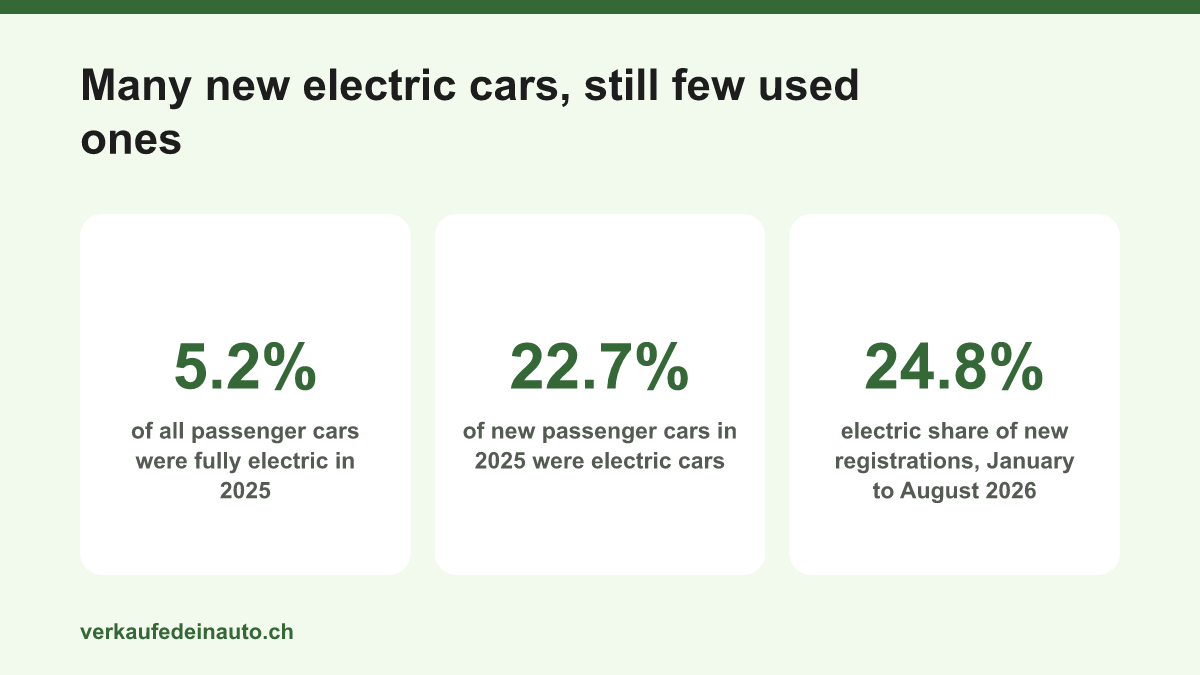
The market for used electric cars is young. According to the Federal Statistical Office, only 5.2 percent of all passenger cars on the road in 2025 were fully electric, while among new cars the figure was already 22.7 percent. From January to August 2026, their share of new registrations was 24.8 percent, according to auto-schweiz. Whatever is registered new today will be up for sale as a used car in a few years. So the supply is growing from year to year.
Three things set this market apart from the one for gasoline and diesel cars:
- The battery as an unknown: According to the TCS, it can account for 30 to 50 percent of the total cost of an electric car. If buyers can’t assess its condition, they factor in a discount for the risk.
- Technology and new car prices: New models and price changes for new cars have a direct effect on the prices of their predecessors.
- The pool of buyers: An electric car mainly suits people who can charge at home or at work.
The first point is in your own hands: the more you can prove, the smaller the discount.
Battery health: prove it, don’t just claim it
What the SoH tells you
The state of health (SoH) indicates how much of its original capacity the battery still has. At 90 percent SoH, 90 percent of the capacity remains, and with it about 90 percent of the range the car had when new.
In 2025, the TCS analyzed the readings of around 130 vehicles from its technical centers. For cars up to five years old and with up to 75’000 kilometers, the SoH was above 90 percent in 87 percent of cases, and none was below 85 percent. Values below 85 percent mainly concerned first-generation models (roughly 2019 and older) or cars with more than 200’000 kilometers. The sample is small, but it shows that for a younger car, a certificate usually confirms a good value, and for an older one, it provides clarity.
How to get a battery report
| Where | What you get | Cost |
|---|---|---|
| TCS, technical centers | Battery test via the diagnostic port, with a certificate | around CHF 75 for members |
| Authorized dealer or workshop | Battery test with a certificate | varies by garage |
| On-board computer | SoH display on some models | free, no certificate |
SwissEnergy advises buyers to ask for such a certificate once a car has covered 50’000 kilometers or is three years old. If you already have one, you’re a step ahead. However, the test only tells you about the capacity, not about the battery’s housing, cooling or electronics.
What is your car worth?
Get a free offer without obligation in a few minutes.
Battery warranty: what it covers and whether it goes with the car
Most manufacturers give a separate warranty on the traction battery. SwissEnergy cites 8 to 10 years and 150’000 to 200’000 kilometers; as a rule, at least 70 percent of the original capacity is guaranteed. According to SwissEnergy, the warranty also remains valid when the car is bought used.
One example is the warranty terms of AMAG Import AG for Volkswagen (as of August 2026): eight years or 160’000 kilometers, whichever comes first. If an authorized workshop measures less than 70 percent of the original usable energy content, this counts as excessive loss. If the car is sold, the new owner takes over the warranty. The condition is that all service work has been carried out according to the manufacturer’s specifications.
- Work out how long the battery warranty still runs and how many kilometers are left, and state both.
- Include the service records. Without them, the warranty is worth less to the buyer.
- If the warranty is about to run out, have the SoH measured beforehand. SwissEnergy recommends a check a few weeks before it expires. If you’re planning to sell anyway, it makes sense to schedule the sale before the warranty ends; more on this in the guide on the right time to sell.
- Read your brand’s terms, because the duration and details vary.
Range and charging: what buyers ask
State the range as it is today. As a rule of thumb, take the standard range (WLTP) times the SoH; in everyday driving, speed and temperature also come into play. SwissEnergy estimates around one percent less range for every degree the outside temperature falls below 23 degrees Celsius. A photo of the range display with a full battery says more than the brochure figure.
- Charging with alternating current (AC): State the power of the on-board charger in kW. How fast the car charges at a wallbox depends on it, because the weakest link among the car, cable and charging station sets the pace.
- Fast charging with direct current (DC): State the connector and the maximum charging power. Buyers check whether fast charging is possible via CCS, the connector that is widespread in Europe; some older models, especially from Japanese brands, use CHAdeMO.
- Equipment: Mention a heat pump, a larger battery option or the towing capacity in the listing.
Software, account and paid features
With connected cars, part of the value lies in the software. What matters is what is tied to the vehicle and what is tied to your user account.
- Tied to the car: features purchased later on. Volkswagen, for example, states that purchased upgrades remain in the vehicle for the duration of the activation, can be used by all drivers and cannot be transferred to other vehicles. You can list such features as equipment.
- Tied to the account: online services and subscriptions. These are based on a contract linked to your user account, and the buyer has to link the car to their own account. Don’t promise any services that end with your account.
- Discontinued services: On older models, some app services no longer work because the 2G and 3G mobile networks are being shut down. Check in the app what still works, and say so openly.
At the handover, remove the car from your manufacturer account and from the app. Delete profiles, your home address, paired phones and stored charging cards, and reset the infotainment system to factory settings. Otherwise, a car that is no longer yours stays linked to your account, and depending on the brand, the buyer can only register it to their own account once you’ve done this. How this works with Tesla is shown on the page Selling a Tesla.
Cables, wallbox, tires and brakes
- Charging cables: Buyers expect the Type 2 cable for charging stations and the charger for household outlets. If one is missing, the buyer deducts the cost of a replacement from the price.
- Wallbox: The wallbox belongs to the house, not to the car. You can keep it, sell it separately or offer it to the buyer. It rarely makes a difference to the car’s price, because the buyer first has to have it installed at their own home.
- Tires: Electric cars are heavy because of the battery, and the tires need the load capacity required by the manufacturer. Buyers also look at the tread and age.
- Brakes: Because the car mostly slows down using the motor, the disc brakes get little use and can start to rust. Take a look at the discs before you offer the car for sale.
Preparation: from measuring the battery to the handover
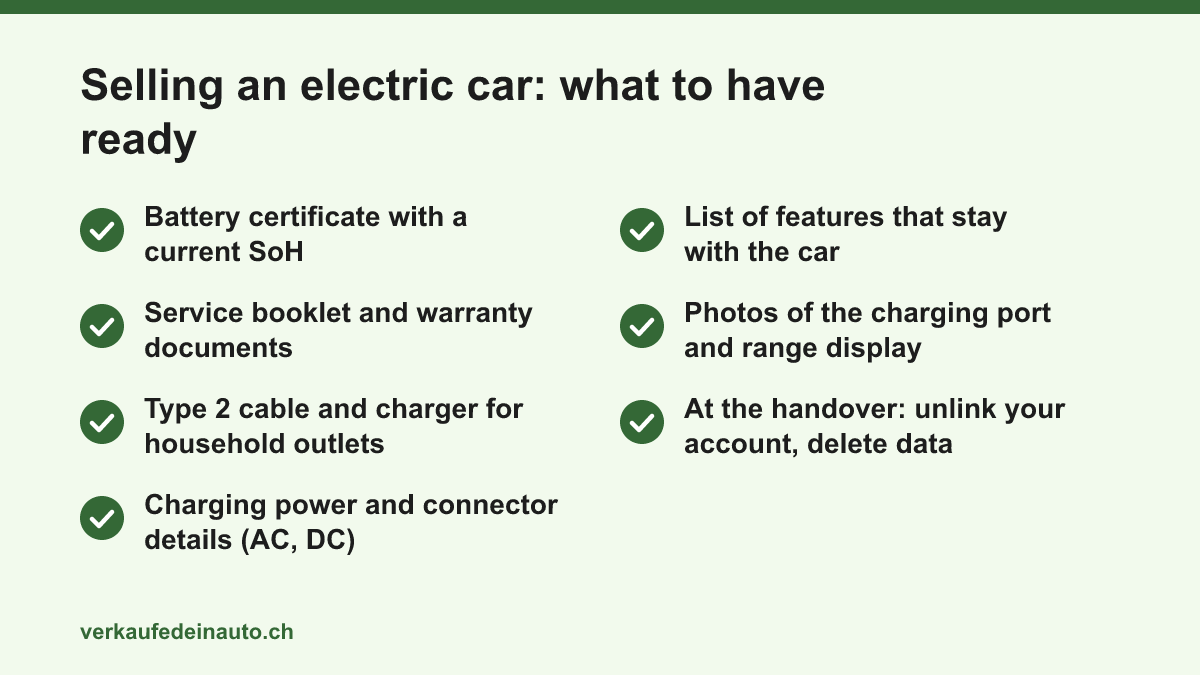
- Two to three weeks before: Get a battery report, gather the vehicle registration document (Fahrzeugausweis), service records and warranty documents, and find the charging cables.
- One week before: Clean and photograph the car, including the charging port, cables, range display and certificate. The guide Photographing your car for sale shows what a complete set looks like.
- In your listing or when you request an offer: State the SoH with the date and testing center, the remaining warranty, the charging power and the features that stay with the car.
- At the handover: Remove the car from your account and the app, reset the data, and hand over all cables and documents.
Tip
Be specific about the battery health, for example “SoH 92 percent, certificate dated September 12”. Nobody will believe a number without proof and a date.
The guide Selling your car online in Switzerland compares the ways to sell online. If your electric car is leased, first read how selling a leased car works.
You can also sell an electric car at verkaufedeinauto.ch. It’s best to send the battery report right away with the vehicle data and photos: the more precise the information, the more reliable the firm price. If the car matches the description at the handover, there is no further negotiation. The amount is paid out by instant bank transfer, and we take care of the deregistration. Request your offer here.
Frequently asked questions
How do I find out the battery health of my electric car?
The most reliable way is a battery test. The state of health is read out via the diagnostic port, and you receive a certificate. This is offered at TCS technical centers, authorized dealers and independent workshops; at the TCS, the test costs members around CHF 75. Some models also show the value in the on-board computer. For the sale, the certificate counts for more than a photo of the display, because it comes from a neutral party.
Does the battery warranty pass to the buyer when I sell the car?
As a rule, yes, because the warranty is tied to the vehicle, not to the person. According to SwissEnergy, it also applies when a car is bought used, and the warranty terms for Volkswagen in Switzerland expressly state that the new owner takes over the warranty. It is usually conditional on service work according to the manufacturer’s specifications. Check your brand’s terms and give the buyer the service booklet and warranty documents.
Does an electric car lose value faster than a gasoline car?
There’s no general answer; it depends on the model, the battery and demand. Three things have a stronger effect with an electric car: uncertainty about the battery health, new models and price changes for new cars, and the smaller pool of buyers, because not everyone can charge at home. The first point is in your own hands: a current battery certificate and complete service records remove the biggest risk for the buyer.
Should I sell the wallbox together with the car?
That’s possible, but rarely necessary. The wallbox is permanently installed at the house and usually also works with the next electric car. If you continue to charge at home, keep it. If you’re switching, you can offer it to the buyer or sell it separately; removal and installation at the new location are a job for a professional. The car’s charging cables, on the other hand, always go with the car.
What do I need to delete in the car and in the app before the handover?
Remove the car from your account with the manufacturer and from the app. Delete driver profiles, your home address and navigation destinations, paired phones, login details for streaming services and stored charging cards. The most thorough option is a reset to factory settings. Cancel any ongoing subscriptions or let them run out. Do all this only at the handover, once the sale is complete, because you may still need the app until then.
Sources
- Federal Statistical Office: Renewed surge in electric vehicles (press release of February 4, 2026) (in German)
- auto-schweiz: New passenger cars August 2026 (press release of September 1, 2026) (in German)
- TCS: Analysis of the batteries of used electric cars (press release) (in German)
- SwissEnergy: Buying a used electric car (in German)
- AMAG Import AG: Volkswagen warranty terms, as of August 1, 2026 (PDF) (in German)
- Volkswagen Switzerland: Digital extras (in German)