Photographing your car for sale: pictures buyers trust
Your photos decide whether buyers trust your listing and whether a car buyer can name a firm price. Here’s how to put together a complete, honest set of pictures.
In short
- A clean car, soft light, a calm background: these count for more than the camera.
- A complete set shows the exterior, interior, instrument cluster, tires, papers and all damage.
- In a listing, cover the license plate and leave out the vehicle registration document.
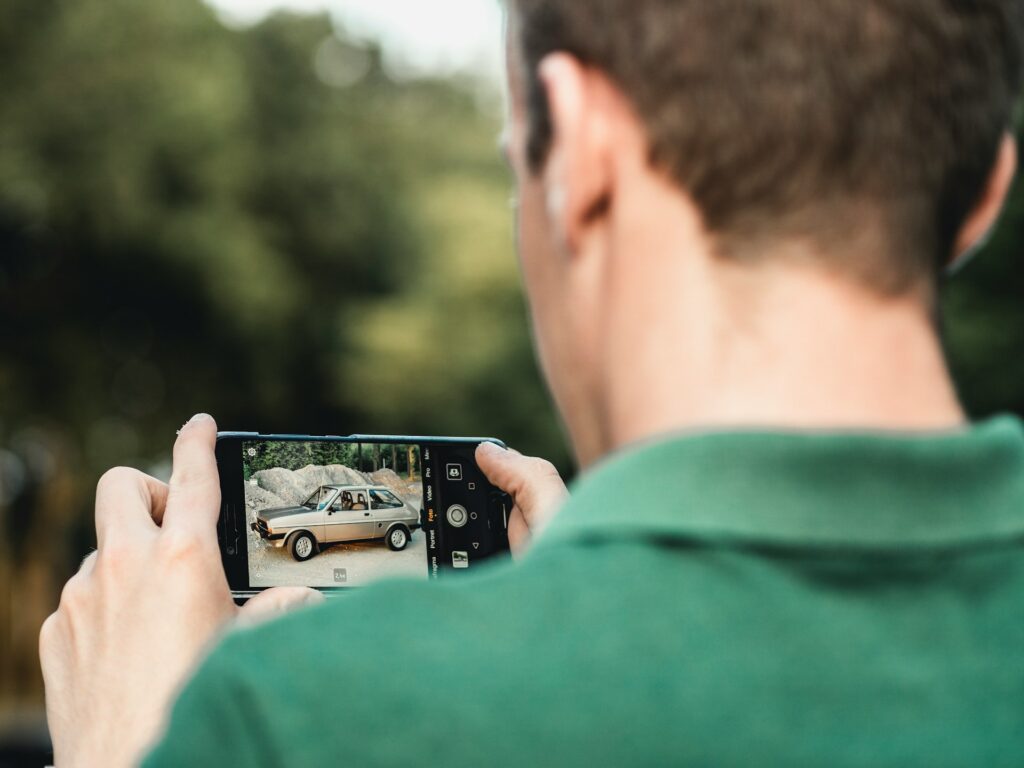
If you want to photograph your car to sell it, you don’t need an expensive camera, just a clean car, soft light and a plan. The pictures are the first thing a buyer sees of your car, and often the only thing an online car buyer bases their price on. If one side is missing or damage can only be guessed at, everyone assumes the worst.
How to write the listing and which platform to post it on is covered in the guide Listing your car in Switzerland. This guide is about the pictures themselves: preparation, light, the shots you need, phone settings and privacy.
Preparation: clean, but don’t gloss over anything
Cleaning isn’t cosmetic. Only on clean paint can you tell what’s a scratch and what’s just dirt.
- Exterior: wash and dry it, including the rims, door jambs and windows. Water drops and streaks look like paint defects in photos.
- Interior: vacuum, wipe down the dashboard, clean the windows from the inside. Take out the child seat, phone holder, parking permits and trash.
- Trunk: empty it completely, including the compartment under the trunk floor.
- Have ready: all keys, the service booklet, the vehicle registration document (Fahrzeugausweis), invoices for major work and the second set of wheels.
- License plates: cover them for the photos of a public listing, for example with a piece of cardboard. The reason is explained below.
What you should avoid: hiding damage. Paint sprayed with water, a cleverly chosen shadow or polish over a rust spot will be noticed at the viewing, if not sooner, and then the trust is gone.
Location, light and angle
The location: quiet, level and with a neutral background, such as a light-colored wall or an empty parking lot. You need a few steps of space all around the car so that it fits completely into the frame. Other people’s cars, passersby and your front door don’t belong in the photo.
The light: The easiest time to photograph your car is when the sky is overcast. The light is soft then, the paint reflects less and there are no harsh shadows. When it’s sunny, take your photos in the morning or later in the afternoon, with the sun behind you. Midday sun, dusk, underground garages and flash make any car look worse than it is. If the sun is in an awkward position, turn the car, not yourself: that way, all sides get the same light.
The angle: Hold your phone at about the height of the door handles rather than at eye level; that way, the proportions are right. Keep the same distance for all exterior shots, leave some space around the car and shoot in landscape format.
Tip
Stick to a fixed order for the exterior shots: start at the front left and go around clockwise. That way, no view is missing at the end.
Phone settings and format
A current smartphone is enough. A few settings matter more than the device:
- Use the main camera: The ultra-wide lens distorts the proportions, and digital zoom costs sharpness. It’s better to take a step back or move closer.
- Clean the lens, turn on the grid: A fingerprint makes every picture look hazy, and the grid helps you keep things straight.
- No filter, no portrait mode, no flash: The color should look the way it does in real life.
- Full resolution: Messaging apps often shrink pictures a lot. Upload the photos directly or send them in their original size.
- File format: iPhones usually save photos in HEIF, a space-saving format. If an upload doesn’t accept it, go to “Settings”, “Camera”, “Formats” and switch to “Most Compatible”; the iPhone then creates JPEG files.
You shouldn’t edit the pictures. AutoScout24’s listing rules, for example, only allow original pictures that show the car’s actual condition, and apart from a neutral virtual background, they don’t allow any image editing.
What is your car worth?
Get a free offer without obligation in a few minutes.
Photograph your car: the shots for a complete set
A complete set answers the questions a buyer would ask at a viewing. Work your way from the outside in.
Exterior
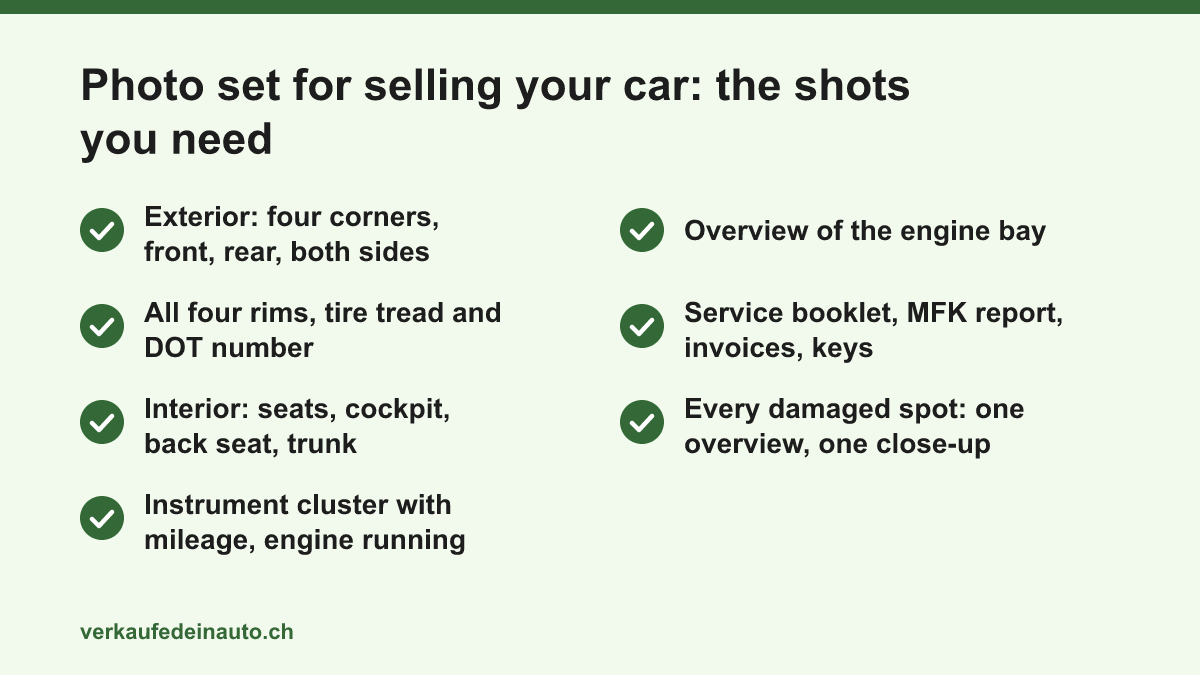
Four shots at an angle from the corners, plus the front, rear and both sides. That way, every body panel can be seen at least twice, and nobody wonders what’s wrong with the missing side. If there’s hail damage or faded paint, include the roof too.
Wheels and tires
Photograph each rim separately, because curb damage is rarely on all four. Add a close-up of the tread and the DOT number on the sidewall of the tire: the last four digits give the week and year of manufacture. A second set of wheels gets its own pictures.
Interior, instrument cluster and trunk
- Driver’s seat, including the outer side bolster, where wear shows first
- The whole cockpit, photographed from the back seat
- Steering wheel, gearshift and the screen switched on
- Back seat and headliner
- Instrument cluster with the engine running: the mileage must be readable, and if a warning light is on, it belongs in the picture
- The empty trunk, plus the compartment with the spare tire or repair kit
Engine bay and documents
For the engine bay, an overview with the hood open is enough. For the documents, what counts are the stamped pages of the service booklet or a printout of the digital service record, the report from the last MFK (vehicle inspection), invoices for major work such as the timing belt or brakes, and all keys side by side. For an electric car, add the charging port, charging cable and battery report; more on this in the guide Selling an electric car.
Damage: always two pictures
Every scratch, dent, stone chip and rust spot gets two shots: one from one to two meters away that shows where on the car the damage is, and a close-up with something for scale, such as a coin or a folding ruler. This also applies inside, from a burn hole to a tear in the leather.
Dents are hard to see in photos. Stand so that a straight edge, such as the wall of a house, is reflected in the paint: where the line kinks, that’s where the dent is.
This quickly adds up to 25 to 30 pictures. If a platform allows fewer, choose the most telling ones.
What costs trust and what builds it
| Costs trust | Builds trust |
|---|---|
| wet car, photos in the rain | dry car in soft light |
| one side missing | all eight exterior views |
| damage only mentioned in the text | overview and close-up |
| warning light cropped out of the picture | whole instrument cluster with the engine running |
| pictures from last summer | current pictures of its present condition |
| catalog picture of the model | only your own car |
Being open protects you too. Under Art. 200 CO, the seller is not liable for defects the buyer knew about at the time of purchase, and a photo in the listing or offer helps prove that the damage was known. Conversely, a warranty exclusion is invalid if a defect was fraudulently concealed (Art. 199 CO). Also record known damage in the sales contract. This section provides general information and is not legal advice.
Privacy: what to cover up or leave out
Photos show more than the car. Keep these points under control:
- License plate: The cantons may publish the name and address of registered keepers (Art. 89g para. 5 SVG). That’s why in many cantons you can look up the registered keeper of a plate online or by text message, in the canton of Zurich, for example, via the Autoindex, and in the canton of St. Gallen via the eAutoindex. So a readable plate can lead to your address. Cover it up. You can also have your data blocked at the road traffic office (Strassenverkehrsamt), free of charge and without giving a reason.
- Platform rules: AutoScout24 requires that no license plates, addresses or phone numbers can be seen in the photos and that recognizable faces are made unrecognizable.
- Vehicle registration document: It shows your name and address and doesn’t belong in a public listing. AutoScout24 also advises never to send identity or vehicle documents digitally to supposed prospective buyers, because scammers can misuse them. It’s different with a car buyer you have chosen yourself: they need the vehicle data for the valuation, such as the type approval and first registration. You can cover your name and address as long as they’re not explicitly requested.
- Service booklet and invoices: The date, mileage and work done should be readable; your name, address and customer number should not.
- Location data: If location services are on for the camera, your phone saves the coordinates in every photo. Turn them off or share the pictures without the location.
- Reflections: Paint and windows often reflect you, your house or someone else’s license plate.
Tip
Send yourself a test picture and check the image information to see whether a location has been saved.
Photos for a firm offer
An online car buyer doesn’t see your car before the handover. What they need to know for the price is in your details and your pictures. This is also how verkaufedeinauto.ch works: you enter the vehicle data in the form, upload the photos and receive a firm price. It applies at the handover if the car is as you described and photographed it. That’s why a complete set showing all damage pays off: whatever could be seen in the photos is already taken into account in the price.
The comparison Selling your car online in Switzerland shows what other online options there are. Once your pictures are ready, you can request your free offer here.
Frequently asked questions
How many photos do you need to sell a car?
Enough that no question remains open. Eight exterior views, the four rims, the tread and age of the tires, five to six pictures of the interior, the instrument cluster, trunk, engine bay and the documents already add up to more than 20 shots. On top of that come two pictures per damaged spot. If the platform limits the number, choose the most telling ones.
Do I have to cover the license plate in the photos?
In a public listing, yes. In many cantons, anyone can use the license plate to look up the name and address of the registered keeper, unless the data has been blocked. AutoScout24’s listing rules also require that license plates are not visible in the pictures. It’s best to cover the plates when you take the photos. If you only send the pictures to a car buyer of your choice, the plate isn’t an issue.
Should I really photograph scratches and dents?
Yes. A buyer who only discovers damage at the viewing wonders what else has been kept quiet and negotiates hard accordingly. Damage that was clearly visible in the photos, on the other hand, is already priced in. It also helps you legally: under Art. 200 CO, the seller is not liable for defects the buyer knew about at the time of purchase. Photograph each damaged spot once as an overview and once up close with something for scale.
Is a phone enough, or do I need a real camera?
A phone is enough. Use the main camera instead of the ultra-wide lens, clean the lens and skip filters, portrait mode and flash. Upload the pictures in full resolution, because messaging apps often shrink them a lot. If an upload doesn’t accept the iPhone’s HEIF format, switch the camera to “Most Compatible” in the settings.
Can I photograph and send my vehicle registration document?
To a car buyer or dealer you have chosen yourself, yes: they need the vehicle data for the valuation. You can cover your name and address as long as they’re not explicitly requested. The vehicle registration document doesn’t belong in a public listing, and you shouldn’t send identity or vehicle documents digitally to unknown prospective buyers, because scammers can misuse such copies. The buyer sees the original at the handover.
Sources
- AutoScout24: Listing rules for vehicle photos (in German)
- AutoScout24: Safety tips for selling (in German)
- asa, Association of Road Traffic Offices: Registered keeper lookups and Art. 89g SVG (in German)
- Canton of Zurich: Autoindex and blocking of registered keeper data (in German)
- Code of Obligations (CO, SR 220), Art. 199 and 200
- Apple Support: Using HEIF or HEVC media on Apple devices