Canceling your car insurance after the sale: deadlines and refunds
Car sold, but the policy is still running? What happens to liability and comprehensive or partial cover, when you get premium back and in what order to deal with the plates and insurance.

In short
- The policy doesn’t end on its own: report the sale and say what should happen to it.
- Depositing your plates only suspends the policy; it only ends on your instruction.
- You get any overpaid premium back pro rata (Art. 24 VVG).
The car is sold, but you paid the annual premium long ago. Do you now have to cancel your car insurance, or does it end on its own? Neither is quite right: by law, the insurance initially moves with the car, but in practice it is tied to you as the registered keeper, to your license plates and to the proof of insurance. Here you’ll find out what applies, which deadlines count and how to get back any premium you overpaid. This guide provides general information and is not legal advice; the decisive documents are your policy and the general terms and conditions of insurance (AVB).
What the law provides when you sell: Art. 54 VVG and Art. 67 SVG
The basic rule is in the Insurance Contracts Act (VVG). If the insured object changes owner, the rights and obligations under the contract pass to the new owner (Art. 54 VVG). Three deadlines apply here:
- The new owner can refuse the transfer no later than 30 days after the change of ownership, in writing or in another text form such as email.
- The insurer can cancel the contract within 14 days of learning about the new owner.
- If the insurer cancels, the contract ends 30 days after the cancellation at the earliest.
For mandatory liability insurance, the Road Traffic Act (SVG) has its own rule. If the registered keeper changes, the rights and obligations under the contract pass to the new registered keeper. However, if the new vehicle registration document (Fahrzeugausweis) is issued on the basis of a different liability insurance policy, the old contract expires (Art. 67 SVG). In addition, the previous insurer may withdraw from the contract within 14 days of learning that the registered keeper has changed.
The idea behind this: no motor vehicle may be used on the road without liability insurance (Art. 63 SVG), and a sale should not leave a gap in cover.
Why the policy stays with you in practice
With a car, the buyer rarely ends up continuing your contract. Motor vehicle insurance is tied to three things:
- Registered keeper: The vehicle registration document is in your name. If the car passes to someone else, a new document is needed (Art. 11 SVG).
- License plates: The plate number is assigned to you, not to the car. If you sell privately, you take the plates off.
- Proof of insurance: No car is registered without it. The insurer transmits it electronically, and when another registered keeper takes over the car, a new one is needed (Art. 3a VVV).
So the buyer registers the car with their own proof of insurance, from an insurer of their choice. That settles your liability insurance for this car. For comprehensive or partial cover, Art. 54 VVG applies in principle; however, some policies expressly state that this cover ends when the registered keeper or the owner changes. Generali’s terms and conditions (2026 edition), for example, say so.
It’s different if someone takes over the car together with the plates, for example within the family. The new registered keeper then decides whether to continue the existing policy or take out their own. More on this in the guide Change of ownership of a car.
Tip
Never leave your license plates with a private buyer. As long as the car is driven with your plates, any damage is settled through your policy and can cost you your no-claims bonus.
What is your car worth?
Get a free offer without obligation in a few minutes.
Three options for your policy: transfer, suspend, terminate
What happens to your contract depends on what you do with the plates. You may only keep them if you register another car within 14 days (Art. 74 VZV). Otherwise, you return them or deposit them.
| Plates | Policy | Premium |
|---|---|---|
| on your next car | transfer it or switch insurers | credited or refunded pro rata |
| deposited | on hold (suspension) | credit according to the terms and conditions |
| returned | request termination | remainder refunded pro rata |
Changing cars: the policy moves with you
If you register another car, you move the plates over to it and have the contract adjusted. The insurer issues proof of insurance for the new car and credits the premium you have already paid. You are not tied to your insurer, though: changing cars is a common time to switch insurers. The guide Comprehensive or partial cover explains which cover suits your next car.
Suspension: plates deposited, insurance on hold
If your next car is only coming later, you deposit the plates at the road traffic office (Strassenverkehrsamt). The insurance is then suspended by law, from the day after you hand them in or send them by mail. The office reports the deposit to the insurer (Art. 68 SVG, Art. 8 VVV).
What happens to the premium is governed by the terms and conditions, and they differ. Generali, for example, only grants the discount for the suspension period if the plates have been deposited for at least 14 days, credits it when you register a vehicle again and deducts a processing fee. So ask how long the policy may remain suspended and when you’ll receive the credit.
Tip
If you send the plates by mail, keep the postal receipt. It shows from which day the insurance is suspended.
Termination: no car for the time being
If you’re not planning to get a new car, return the plates and expressly ask the insurer to terminate the contract as of the date of sale. AXA, for example, lists “Insured object sold” as a reason for cancellation and refunds the annual premium pro rata. Don’t rely on the notification from the road traffic office being enough: without your instruction, the contract can simply remain suspended.
How to deposit or return the plates is explained in the guide Deregistering your car after the sale.
Refund: how much premium you get back
The premium is divisible. If the contract ends early, you only owe it up to that point (Art. 24 VVG); you are entitled to a pro rata share of what you paid in advance. The law provides for two exceptions:
- If the insurer has paid out after a total loss, the premium for the current insurance period remains due in full.
- If you cancel after a partial loss in the first year after the contract was concluded, the insurer keeps the premium for the current period (Art. 42 VVG).
Worked example with round assumptions: You paid CHF 1’200 for the whole year on January 1 and sell the car at the end of September. Three of the twelve months are unused, so you get back around CHF 300. If you change cars, this amount is credited toward the premium for the new car.
The cantonal motor vehicle tax is settled by the road traffic office, not by the insurer. More on this under Tax on selling a car.
Cancel your car insurance without a sale: deadlines and special rights
If you only want to switch providers, the ordinary rules apply:
- End of the contract term: As a rule, your cancellation must reach the insurer three months before the contract expires. Otherwise, the contract is tacitly renewed, by law for no more than one year at a time (Art. 47 VVG).
- After three years: Even a contract concluded for a longer term can be canceled as of the end of the third year and of every following year, with three months’ notice (Art. 35a VVG).
- After a claim: If you claim compensation for a partial loss, both sides can withdraw from the contract, by law no later than when the payment is made (Art. 42 VVG). The terms and conditions often give you until 14 days after you learn of the payment. If you cancel, the cover ends 14 days after your notice is received.
- Premium increase: This right is not in the law but in the terms and conditions. With Generali, for example, the change must be announced no later than 25 days before the end of the insurance year, and your cancellation must have arrived by the last day of that year.
In all cases: cancel in writing or by email and ask for a confirmation. What counts is the day your cancellation reaches the insurer, not the postmark.
The right order and what the insurer needs
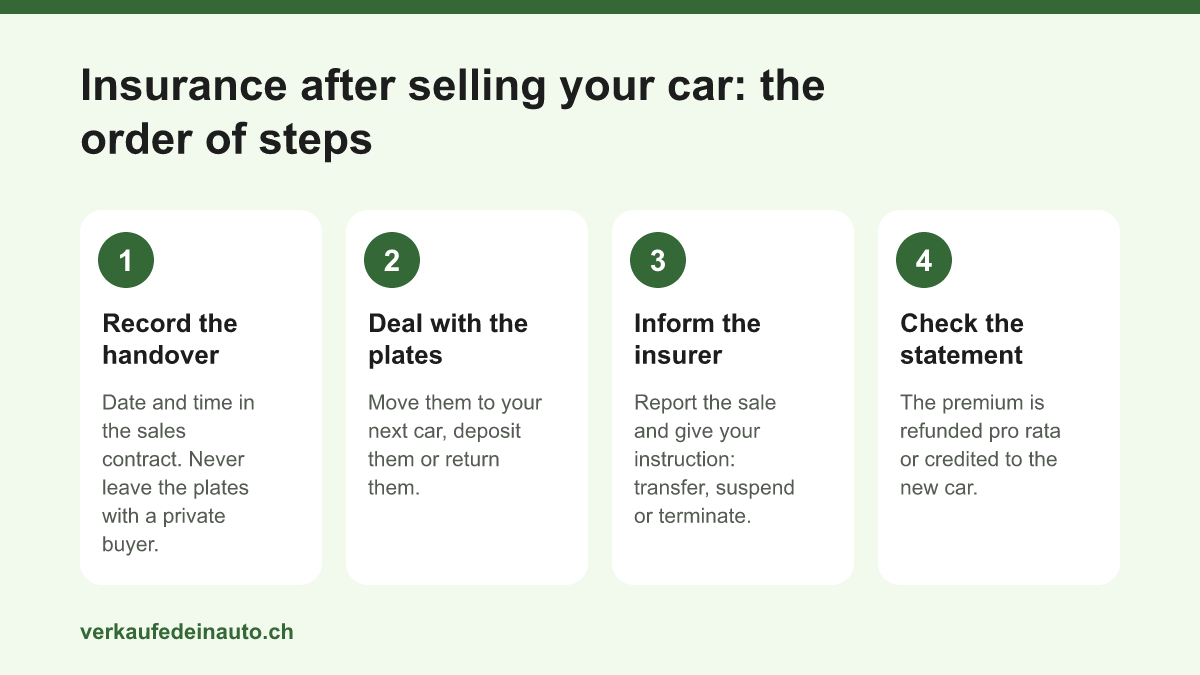
- Don’t cancel early: As long as the car is registered, it needs liability insurance, including for test drives.
- Record the handover: The date and time belong in the sales contract.
- Deal with the plates: move them to your next car, deposit them or return them.
- Inform the insurer: ideally on the same day and in text form.
- Check the statement: Are the end date and the amount of the refund or credit correct?
Your notice to the insurer should include:
- Policy number and license plate number
- Date of sale and, on request, a copy of the sales contract
- Your instruction: change of vehicle, suspension or termination
- For a change of vehicle, the details from the new car’s vehicle registration document
- Your IBAN for the refund
Selling to a dealer or online car buyer
If the buyer takes care of the deregistration, little changes for your policy: have the contract confirm who returns the plates and by when, and still report the sale to your insurer yourself. At verkaufedeinauto.ch, the deregistration at the road traffic office is included. The firm offer is based on your information and photos, and payment is made at the handover by instant bank transfer. This also works for leased cars.
Request your free offer here and take care of the sale, plates and insurance in one go.
Frequently asked questions
Does car insurance end automatically when you sell the car?
Not reliably. For the car you sold, your liability insurance expires as soon as the buyer registers it with a different insurance policy (Art. 67 SVG). But your contract itself is only moved to another car, suspended or terminated once the insurer knows what you want. If you only hand in the plates, the policy can simply remain suspended. So report the sale yourself, state the date and request the change of vehicle or the termination in text form.
Do I get the premium I paid back after selling my car?
Yes, pro rata. Under Art. 24 VVG, the premium is only owed until the contract ends. If you change cars, the insurer credits the unused portion toward the new premium; if you terminate the contract, it transfers the amount to you. There is no refund for the current period after a total loss has been paid out, or if you cancel after a partial loss in the first year of the contract. Provide your IBAN for the payout right away.
Can the buyer take over my car insurance?
Legally, yes: Art. 54 VVG and Art. 67 SVG let the contract pass to the new owner and the new registered keeper respectively, who can refuse the transfer within 30 days. In practice, the buyer needs their own proof of insurance for the new vehicle registration document anyway and usually chooses their own insurer for it. Your liability insurance for this car then expires. The plate number remains assigned to you in any case.
Should I cancel the insurance before the sale?
No. As long as the car is registered in your name, the liability insurance must remain in place; without it, test drives aren’t possible either. If the insurer reports the end of cover to the road traffic office, the office withdraws the vehicle registration document and has the plates seized (Art. 68 SVG, Art. 7 VVV). So change or end the contract as of the date of the handover, and only once the sale is certain.
Can I cancel my car insurance by email?
As a rule, yes. For a cancellation, the Insurance Contracts Act accepts not only written form but any form that allows proof by text, such as an email. What matters is that the cancellation reaches the insurer in time. Ask for a confirmation stating the end date. If a deadline is about to expire, also send a registered letter to be on the safe side.
Sources
- Insurance Contracts Act (VVG), Art. 24, 35a, 42, 47 and 54 – Fedlex (in German)
- Road Traffic Act (SVG), Art. 11, 63, 67 and 68 – Fedlex (in German)
- Road Traffic Insurance Ordinance (VVV), Art. 3a, 7 and 8 – Fedlex (in German)
- TCS: Switching car insurance and registering a vehicle (in German)
- AXA: Canceling your insurance (deadlines, sale of the insured object)
- Generali: General terms and conditions for vehicle insurance, 2026 edition (in German)