Change of ownership for a car: process, costs and deadlines in Switzerland
Who does what when a car is sold? The change of ownership step by step: documents, license plates, costs and deadlines, plus special cases such as leasing, family and death.
In short
- The buyer needs the previous vehicle registration document and proof of insurance.
- You must report the change of ownership to the road traffic office within 14 days.
- With code 178 in the document, someone must consent first, usually the leasing company.
A change of ownership for a car involves two people and one office: you have the vehicle registration document (Fahrzeugausweis) canceled, and the buyer registers the car in their name and receives a new document. Trouble usually arises when one side forgets its part.
The registered keeper is not necessarily the owner. The keeper is whoever actually and permanently has control over the car and uses it in their own interest or at their own expense (Art. 78 VZV). That is why your name is in the vehicle registration document of a leased car, even though the car belongs to the leasing company. This guide gives a general overview and is not legal advice. Fees: as of September 2026.
Change of ownership: the process in four steps
The law does not prescribe an order. This one has proven itself:
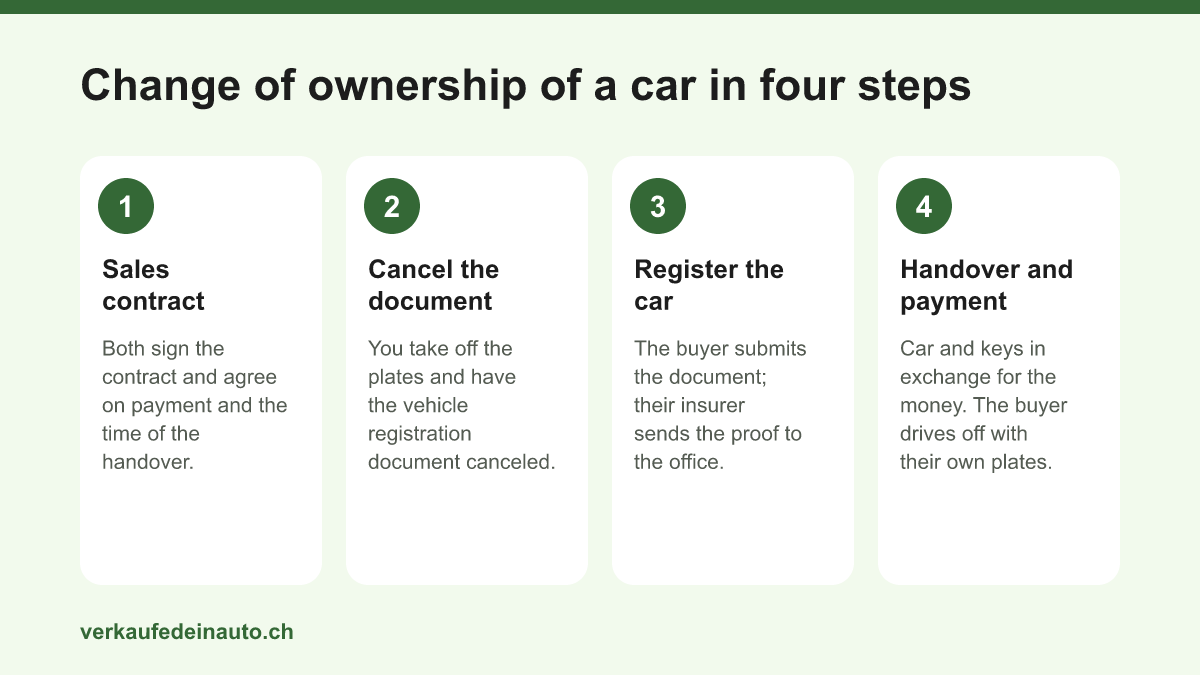
How quickly this goes depends on the buyer’s license plates. If the buyer is replacing their previous car, they already have plates and can take the car with them on the day of the handover: you have the document canceled at the counter, the buyer hands in the documents at the office or the post office, fits their plates and drives off with the provisional authorization to drive. If the buyer has no plates yet, they first need the canceled document to register the car. Until then, the car stays with you. Record in the contract when payment is made and when the car is handed over.
What the buyer needs to register the car
The responsible office is the road traffic office (Strassenverkehrsamt) of the canton where the car will be kept in future. For a car that has been registered before, federal law requires two things (Art. 74 VZV):
- The original of the previous vehicle registration document, usually canceled by the seller. A copy is not enough. If it is lost, the road traffic office issues a duplicate: Lost vehicle registration document.
- Proof of insurance. The buyer orders it from their liability insurer, which sends it electronically to the office (Art. 3a and 4 VVV); it no longer exists on paper.
Depending on the canton, a registration form is also needed. Anyone registering a car in the canton for the first time sometimes needs further documents: in Bern, foreign nationals enclose a copy of their foreign national identity card, and companies an extract from the commercial register.
When an MFK is needed before registration
A fresh inspection is not generally required for a change of ownership. For older cars that have not been inspected for a long time, however, some cantons first require a vehicle inspection (MFK). In Bern, for example, this applies to cars that were first registered more than ten years ago and have not been inspected for more than two years. What counts is the buyer’s canton. More examples and the consequences for the price are in the guide MFK when selling a car.
Tip
Before the handover, ask the buyer in which canton they will register the car and whether their proof of insurance has already been ordered. Then you know whether an inspection comes first and how quickly they can take over the car.
What is your car worth?
Get a free offer without obligation in a few minutes.
License plates: a new number, existing plates or interchangeable plates
In a private sale, your plates do not go with the car. The buyer has three options:
- New plates: A buyer who has none yet receives a new number with the vehicle registration document.
- Existing plates: A buyer who is replacing their previous car registers the new one on the plates they already have. They don’t have to wait for the new document: with the form “Vorläufige Verkehrsberechtigung” (provisional authorization to drive), they may drive an officially inspected car right away, as soon as the proof of insurance is available and the documents have been handed in at the office or mailed at the post office. The completed form must be kept in the car; the authorization is valid for 30 days at most and only in Switzerland (Art. 10b VVV).
- Interchangeable plates: If the buyer keeps their previous car, they can register both cars on one pair of plates, provided both are kept in the same canton. Only the car currently carrying the plates may be driven; each car needs its own vehicle registration document and proof of insurance (Art. 13 to 15 VVV).
Costs and deadlines for a change of ownership
Each canton sets its own fees. Two examples of a change of ownership with new plates:
| Item | Bern | Aargau |
|---|---|---|
| Vehicle registration document | CHF 45 by mail, CHF 55 at the counter | CHF 20 |
| New pair of plates | CHF 45 | CHF 20 |
| Total | CHF 90 to 100 | CHF 40 |
On top of that come the new keeper’s motor vehicle tax and the inspection fee if the office first requires an MFK. These costs are usually borne by the buyer.
As for deadlines, the same rule applies all over Switzerland: anything that requires a new vehicle registration document, including a change of ownership, must be reported to the road traffic office within 14 days (Art. 74 para. 5 VZV). For you, this means: have the document canceled no later than 14 days after the handover. Anyone who reports late risks a fine of up to CHF 100 (Art. 143 VZV).
Special cases: leasing, family, death, moving
Code 178 “change of ownership prohibited”
If the vehicle registration document contains code 178, the change of ownership requires consent: the road traffic office only issues a document to a new keeper once whoever had the code entered has agreed (Art. 80 and 81 VZV). The guide Selling a financed car shows how to have the entry deleted when there is a loan.
It is mainly leasing companies that have the code entered, because the car belongs to them. You request the deletion from the leasing company before the sale; in Zurich, you can check online whether the code is entered or already deleted. How the sale then works is explained on the page Selling a leased car.
Change of ownership within the family
Between spouses, or from parents to a child, the change of ownership follows the normal process too: it takes proof of insurance in the name of the new keeper and a new vehicle registration document. The difference lies in the plates. Several cantons allow the number to be transferred to relatives. The fees vary widely: in Aargau it is CHF 20, while other cantons charge several times that.
Change of ownership after a death
If the registered keeper dies, the car is deregistered or transferred. In Zurich, the relatives send in a death certificate and the deceased person’s driver’s license within 14 days; there, the car and plates can be transferred to a family member or the community of heirs within three months. As a rule, several heirs can only sell the car together. So clarify beforehand who signs; what else needs to be settled is in the guide Selling an inherited car.
Moving to another canton
If you move to another canton with your car, that is not a change of ownership, but it works the same way: in exchange for the old document and new proof of insurance, the new canton issues a new vehicle registration document and new plates. The 14-day deadline applies here too. The old plates go back to the previous canton; if you move to Bern, you can have the Bern office forward them.
What you do as the seller
Your part is shorter, but it determines when tax and insurance end for you:
- Conclude the sales contract and arrange the payment. The guide Car sales contract shows what belongs in it.
- Have the vehicle registration document canceled as soon as the sale is certain, ideally after the payment or a down payment. At the counter, this happens immediately; by mail, it takes a few working days. The buyer gets the canceled original.
- Take off the license plates and return them, deposit them or transfer them to your next car.
- Inform your insurer. What happens to the policy and the premium is explained in the guide Canceling your car insurance after the sale.
You’ll find the deadlines, fees and refunds for this under Deregistering your car after the sale.
If you sell to verkaufedeinauto.ch, all that is left for you of the change of ownership is the handover: the deregistration at the road traffic office is included, and with leased cars, the settlement is made directly with the leasing company. Get your free, non-binding offer here.
Frequently asked questions
Can the buyer drive home with my license plates?
Don’t give them to a private buyer: the plates are assigned to you. If the buyer is replacing a car that is already registered, they drive with their own plates and the provisional authorization to drive. Otherwise, they register the car first and bring the new plates to the handover, or they get a day permit from the road traffic office for 24, 48, 72 or 96 hours (Art. 20 VVV). It is only different if a dealer or car buyer takes over the deregistration by contract.
Who pays the fees for a change of ownership?
Usually each side pays its own. The buyer pays for the new vehicle registration document, new plates if needed and any inspection the office requires. For you as the seller, the deregistration costs nothing in many cantons. You can also agree on something else in the sales contract, for example who pays for an MFK before the handover.
What happens if the buyer doesn’t register the car in their name?
Nothing, as far as you are concerned, provided you have had the vehicle registration document canceled and have returned the plates, deposited them or transferred them to your next car. When the buyer registers the car is then their business. It gets tricky if you handed over the plates or a valid document: the car then keeps running on your insurance and, with the plates, on your tax too. So have the document canceled yourself or get a written assurance that the car will be deregistered by a set deadline.
Can two people be named as keepers in the vehicle registration document?
No, one person is entered. If several people use the car together and are therefore all keepers, they designate one person who is responsible to the office; that person is named in the document (Art. 78 VZV). For couples and families, this means: if the registered person changes, it is a change of ownership with new proof of insurance and a new document, even if the car stays in the same garage.
Can the change of ownership be done online?
Only partly. The proof of insurance goes entirely electronically between the insurer and the road traffic office. But the buyer takes the original vehicle registration document to the counter or sends it by mail; in Bern, mail is the normal route, and the document costs CHF 10 more at the counter. Anyone who already has plates can bridge the processing time with the provisional authorization to drive.
Sources
- Road Traffic Licensing Ordinance (VZV, SR 741.51), Art. 74, 78, 80, 81 and 143 (in German)
- Road Traffic Insurance Ordinance (VVV, SR 741.31), Art. 3a, 4, 10b, 13–15 and 20 (in German)
- Canton of Zurich, Road Traffic Office: Vehicles & license plates (in German)
- Canton of Bern, Road Traffic and Navigation Office: Registering a vehicle, procedure and fees (in German)
- Canton of Bern, Road Traffic and Navigation Office: Documents for registration (in German)
- Canton of Aargau, Road Traffic Office: Vehicle fees (in German)