Compare car buyers: how to find the right car buying company
Auction, garage, direct purchase or brokerage: how providers in Switzerland work according to their own websites, and seven questions you can use to check any car buyer.

In short
- There is no single best car buying company for everyone: what counts is what suits your car.
- First question for any provider: is the figure a firm offer, a guide value or a bid?
- We buy cars ourselves and aren’t neutral; the facts come from the providers’ websites.
If you search for “compare car buyers”, you’re hoping for a simple answer: the company that pays the most. It’s not that simple, because providers in Switzerland work with different business models. A highest bid, an online estimate and a firm offer can only be compared once you know what each of them still leaves open.
That’s why this guide doesn’t rank providers or compare purchase prices. It shows how four providers and one common type of provider work, based on their own information, and gives you seven questions to ask any car buyer. The ways of selling themselves are explained in the guide Selling your car online.
Transparency
This comparison is written by verkaufedeinauto.ch; we buy cars ourselves and are therefore not neutral. The information on other providers comes from their own websites; the date is given further down, in the overview. Check it on those websites before you decide.
Compare car buyers: seven questions for every provider
You can check these points with any provider: on the website, in the terms and conditions or by asking.
- Firm figure or estimate? Is the first figure a binding offer, a guide value or a dealer’s bid? On most websites, “non-binding” only means that you don’t have to sell. Whether the amount also binds the buyer is a separate question.
- What can still change the price? A viewing, a workshop inspection or information that isn’t accurate.
- When and how do you get the money? In cash or by bank transfer; before, at or after the handover?
- Who handles the deregistration? The contract should state who deregisters the car and by when; more on this in the guide Deregistering your car.
- What does it cost you? A success fee, a flat fee, a commission or a valuation you have to pay for.
- Which cars are accepted? There may be restrictions, for example on leased cars or on the car’s age. Also ask about damage, an expired MFK (vehicle inspection) and high mileage.
- Who is your contracting party? On platforms, a dealer buys the car, not the platform. Look up the company named in the offer and contract in the commercial register at zefix.ch; small sole proprietorships don’t have to be registered there.
The business models at a glance
As of September 30, 2026. The selection is not a complete overview of the market; it shows one example of each business model. First, the business models, without naming names:
| Business model | Who buys your car | How the price is set |
|---|---|---|
| Dealer auction | a registered dealer | bids within a fixed time frame, you decide |
| Garage group | the group, through one of its garages | offer online, final price after a workshop inspection |
| Direct purchase | the car buying company | offer based on your information or after a viewing |
| Brokerage | a buyer found by the broker | price in the listing after an inspection, set together with you |
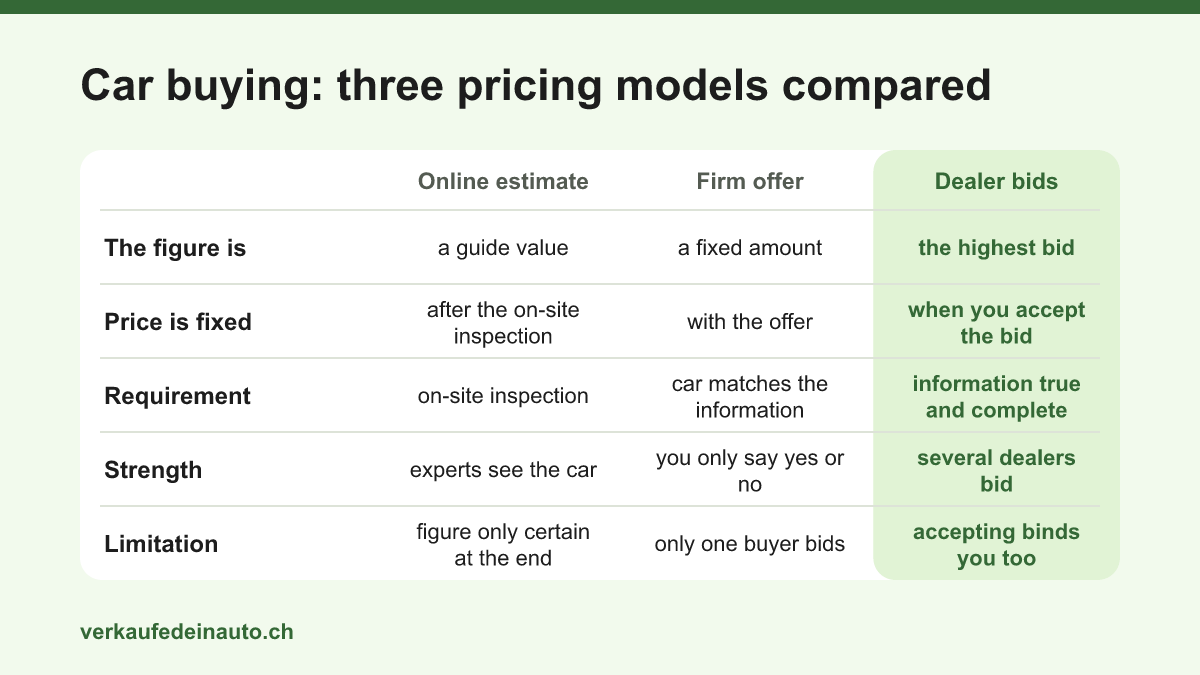
When it comes to the price itself, there are three basic models:
Car buying companies and platforms: how they work
All providers are described using the same criteria. If a point is missing, the pages linked below give no clear information on it.
AutoScout24 Direct: dealer auction over 24 hours
- Who buys: a registered dealer. The platform is operated by SMG Swiss Marketplace Group AG.
- Price: AutoScout24 checks your information, then dealers can bid for 24 hours. After that, you have 48 hours to accept, reject or make one counteroffer. According to the terms and conditions, bids that have been placed and accepted are binding, and so is your counteroffer.
- Handover and payment: The dealer comes to you; according to the terms and conditions, the costs of this and the related formalities are the dealer’s responsibility and must be included in the bid. You and the dealer arrange the payment directly.
- Costs: Dealers pay a fee if the sale goes through. Find out whether sellers pay anything, and how much, before you list your car.
- Cars: according to the terms and conditions, private cars that belong to you and are unencumbered.
Right for you if you want several dealers to bid on your car at the same time.
AMAG: buying through the garage network
- Who buys: AMAG, through an AMAG garage near you that it suggests to you.
- Price: You enter the vehicle data, your desired price and pictures online and receive an offer. This is followed by a workshop inspection, and you agree on the price with the garage.
- Handover and payment: at the AMAG garage you bring the car to. The agreed amount comes directly from the garage.
- Costs: The valuation is free and doesn’t commit you to anything.
- Deregistration: AMAG takes care of it, and of the insurance as well.
- Cars: any make.
Right for you if you want to complete the sale in person at a garage near you.
SwissCarMarket: direct purchase by a dealer
- Who buys: SwissCarMarket, a used car dealer. According to the terms and conditions, the buyer is AK Automobile GmbH.
- Price: You enter the vehicle data in an online form and receive a purchase offer, which you confirm online or by phone. According to the terms and conditions, the sales contract is concluded when you confirm the purchase in writing.
- Handover and payment: at your place. The agreed amount is paid directly at the handover.
- Costs: The valuation and offer are free and don’t commit you to anything.
- Cars: all makes, regardless of condition and mileage.
Right for you if you want to sell directly to a dealer, with the handover at your place.
TCS: brokerage instead of purchase
- Who buys: a buyer found by the TCS.
- Price: An expert inspects the car in the TCS used car test and sets the selling price with you; the car is then listed on AutoScout24. The contract runs for three months from the date of listing.
- Handover and payment: With the basic package, you sell the car yourself using documents from the TCS. With the premium package, the TCS handles the negotiations and the handover, and the car stays with the TCS until it is sold. Payment is made by bank transfer before the handover.
- Costs: With the basic package, members pay a flat processing fee of CHF 290 plus a commission if the car sells; higher rates apply to non-members and to the premium package. If no contract is concluded after the test, the TCS charges a minimum flat fee.
- Deregistration: by the TCS with the premium package.
- Cars: Motorcycles and some other types of vehicles are excluded.
Right for you if you want to leave the inspection, pricing and listing to a broker.
Traditional car buyers and export dealers
If you search for “car buying”, you’ll come across many dealers who buy cars all over Switzerland and export some of them. We read five such websites and don’t name any individual company.
- Who buys: the dealer itself.
- Price: Your request via form, phone or WhatsApp is followed by an offer that doesn’t commit you to anything, and then usually by a viewing at your place or at an agreed location. Three of the five websites describe their offer as binding, as a fixed price or as an offer without renegotiation; the others say nothing about this.
- Handover and payment: usually at your place, in cash or by bank transfer.
- Costs: The request and offer are free.
- Deregistration: handled by the dealer in four of the five cases.
- Cars: all makes and conditions; one website sets an age limit.
Right for you if your car is older or damaged and you want a buyer to look at it at your place.
How verkaufedeinauto.ch works
The same criteria apply to us.
- Who buys: verkaufedeinauto.ch. It is operated by Wüstenvogel Automobile GmbH.
- Price: The form gives you an initial valuation that doesn’t commit you to anything. Once we have your photos and the vehicle registration document (Fahrzeugausweis), you receive a firm offer. At the handover, we look at the car: if it matches your information, the amount stands; if it differs, the amount is no longer firm.
- Handover and payment: We arrange the place and time after you accept. Payment is made at the handover by instant bank transfer, and smaller amounts can be paid in cash on request.
- Costs: The valuation is free.
- Deregistration: we take care of it.
- Cars: all makes, including leased cars, cars for export and cars with an expired MFK, high mileage or damage.
We’re not the best choice if you have time for a private sale: it usually brings in more, because as a dealer, we factor in reconditioning, wages and our margin. And with us, only one buyer makes an offer; if you want several dealers to bid, an auction is a better fit.
Right for you if you prefer a single firm offer to an auction.
What is your car worth?
Get a free offer without obligation in a few minutes.
Best car buying company? How to compare offers
There is no single best car buying company for everyone. When you compare car buyers, you find out which business model suits your car, your schedule and your price target. Here’s how to go about it:
- Send two to three requests on the same day. Use the same information and photos everywhere, and mention every bit of damage. Depending on the business model, the figures come after the request, after an auction or only after an appointment.
- Write down what is firm. For each figure: binding or a guide value, valid until when, and what could change it?
- Subtract the costs. Fees, flat charges, commissions and your own effort for trips and appointments.
- Read the contract before you accept. The company, price, payment method, handover date and deregistration belong in it, as the guide Car sales contract shows. On platforms, accepting a bid already binds you.

The guide Used car value gives you a reference point for the price; if you’re in a hurry, the page Sell your car fast will help. One of the figures you compare can be our offer: the form is free and doesn’t commit you to anything. This guide provides general information and is not legal advice.
Reputable car buying: these signs mean you should walk away
Our page Car buying in Switzerland shows how to check a car buyer. Swiss Crime Prevention (SCP) describes the following warning signs for online marketplaces; they apply to any buyer.
- Time pressure. According to the SCP, pressure is deliberately built up so that there’s no time left to check things.
- Proof instead of money. The SCP advises not to trust payment confirmations and not to hand anything over until the amount has verifiably arrived in your account.
- Overpayment. Someone supposedly pays more than you asked for or wants an advance for expenses: according to the SCP, these are signs of fraud.
Frequently asked questions
Which car buying company is the best?
There is no single best car buying company for everyone; which one suits you depends on your car and your goal. If you want several dealers to bid at the same time, an auction is the right fit. If you want to know the amount before you commit, ask every provider whether the figure is binding and under what conditions it applies. And if you have time for a private sale, you’ll usually get more that way than with us.
Is car buying a reputable business?
Yes. It’s an everyday business for dealers to buy used cars directly from private individuals. Points you can check with any company: an entry in the commercial register (small sole proprietorships don’t have to be registered), a price stated in writing, a clear rule on when and how payment is made, and a sales contract that also covers the deregistration.
Why do the offers for the same car differ?
Because you’re not comparing like with like. An online estimate is a guide value before the inspection, an auction bid is the price of a single dealer, and a firm offer is an amount that applies if your information is accurate. On top of that, every dealer calculates differently: reconditioning, time on the lot, margin and sales channel vary.
Does selling to a car buyer cost anything?
That depends on the business model. With direct buyers and garages, the valuation and offer are usually free. Platforms fund themselves through fees that are charged when a sale goes through; who pays them is stated in the platform’s pricing information and terms and conditions. Brokerage costs a flat fee plus a commission if the car sells.
Sources
- AutoScout24 Direct: How it works (page for dealers) (in German)
- AutoScout24 Direct: General terms and conditions (in German)
- AMAG: AMAG buys your car
- SwissCarMarket: Sell your car in Switzerland
- SwissCarMarket: Car buying in Switzerland
- SwissCarMarket: General terms and conditions for the purchase of used vehicles
- TCS: Selling your car with the TCS (in German)
- TCS guide “Selling a vehicle” (2019, PDF) (in German)
- Swiss Crime Prevention (SCP): Classified ad fraud (in German)
- Zefix: Central Business Name Index of the Confederation
- Code of Obligations (CO, SR 220), Art. 931