Selling your car online in Switzerland: listing, direct purchase or auction?
Listing, direct purchase, dealer auction or a request to a garage: who sets the price, what it costs you, when the money arrives and where the risks lurk.

In short
- Four online options: list it yourself, direct purchase, dealer auction, request to a garage.
- What matters is whether the quoted figure is binding or just an estimate.
- To receive money, you never have to enter card, e-banking or TWINT details.
When you sell your car online, that can mean four different things: listing it yourself, selling it to an online car buyer, having dealers bid on a platform or asking a garage for a quote. The options differ less in the technology than in four questions: Who sets the price? Who does the work? When does the money arrive? And how binding is the figure on the screen?
You’ll find the basic comparison of a private sale, a dealer and an online car buyer in the article How selling a car in Switzerland works today. This guide looks at the online options in detail. How individual providers work and what to judge them by is shown in the car buyer comparison.
How to sell your car online: the four options at a glance
| Option | Who sets the price | When the money arrives |
|---|---|---|
| Listing on a marketplace | you, the buyer negotiates | as soon as a buyer is found |
| Online direct purchase | the car buyer, you say yes or no | at the handover |
| Dealer auction | the highest bid, you decide | after the auction and handover |
| Request to a garage | the garage, after an on-site inspection | after the contract is concluded |
As a rule of thumb: the more you take on yourself, the more of the price stays with you, and the more time and risk you carry.
Option 1: List it yourself on a marketplace
You put your car on a marketplace such as AutoScout24, tutti.ch or anibis.ch, with photos, a description and a price. Interested buyers get in touch, view the car, take a test drive and negotiate. You handle the contract, payment and deregistration yourself.
- Effort: high. You answer inquiries, arrange appointments and are present at every viewing.
- Time: open-ended. A car in demand at a fair market price sells quickly; a niche model can sit for a long time.
- Price: You set it, the buyer negotiates. Because no dealer earns a margin in between, this is where you can get the most.
- Costs: a listing fee depending on the platform and package, plus your time.
- Risk: You deal with strangers. The typical scams are described further down.
- Suits you if: your car is in demand and well maintained, and you are patient.
What the individual platforms cost private sellers and how to put together a listing is shown in our comparison of listing platforms.
Option 2: Direct purchase by an online car buyer
You enter the vehicle details in a form, upload photos and are given a price. If you accept, the handover, payment and paperwork follow. The car buyer is a dealer who resells the car; their effort and risk are factored into the price.
What matters is what the quoted figure means. There are two models:
- Firm offer: The price applies if the car matches your information and photos.
- Online estimate: The figure is a guide value. The final price is only set after an on-site inspection.
Both are legitimate, but they are not the same. Before the appointment, ask in writing which model applies.
- Effort: low. A form, photos and an appointment for the handover.
- Time: usually a few days from the request to the money.
- Price: The car buyer names it. It is lower than what a patient private sale can bring in.
- Costs: usually no fee. Ask whether the deregistration is included.
- Risk: If it is only an estimate, the price can drop on site.
- Suits you if: you want to sell quickly and predictably, or your car has defects that put off private buyers.
Tip
Check the car buyer in the commercial register at zefix.ch. A registered company with an address is not in itself proof of trustworthiness, but it is the minimum.
What is your car worth?
Get a free offer without obligation in a few minutes.
Option 3: Dealer auction
On a bidding platform, you describe your car online. The platform checks the information and shows the car to registered dealers, who bid during a fixed period. At the end, you decide on the highest bid.
One example is AutoScout24 Direct. According to the provider, the auction runs for 24 hours, and only verified dealers may bid. After that, you have 48 hours to accept or reject the highest bid or to make a single counteroffer. The terms and conditions contain three points you should know:
- Bids that have been placed and accepted are binding. When the auction is successfully completed, a sales contract is concluded.
- The car must be yours and unencumbered, and you must describe its condition completely and truthfully.
- You agree on payment and the warranty directly with the dealer.
For your decision, this means:
- Effort: low to medium. The description must be complete.
- Time: a few days until the decision, then an appointment with the dealer.
- Price: the highest dealer bid, that is, the price level of the trade.
- Costs: If the sale succeeds, users owe the platform a fee. Before you start, ask about the current fee for sellers.
- Risk: An accepted bid binds you too.
- Suits you if: you want several dealer prices at once without asking around yourself.
Option 4: Purchase or trade-in request to a garage
Many garages and dealer groups accept requests online. At AMAG, for example, you enter the vehicle details, your desired price and pictures and receive an offer. You then take the car to one of their branches for a workshop inspection, and you agree on the price on site. So the online assessment is the first step, not the end point.
- Effort: medium, because it includes an appointment at the branch.
- Time: depends on the appointment.
- Price: The garage names it after the inspection. With a trade-in, it is usually offset against your next car; in that case, compare the whole deal, not just the trade-in price.
- Costs: none directly.
- Risk: The price is only fixed after the inspection at the branch.
- Suits you if: you are buying your next car from this garage anyway.
Online risks and how to keep them low
Scams targeting listings
Most inquiries are genuine. However, Swiss Crime Prevention (SCP) describes patterns that specifically target sellers:
- Fake buyers: Someone supposedly lives abroad, wants to buy without a viewing and sends a forged payment receipt. Or the transfer is said to be “blocked” until you pay fees.
- Fake delivery services: A shipping company is supposed to take over the car, and you are asked to advance a fee for this or enter card details. According to the SCP, there are no officially supported delivery services on classified ad portals.
- Phishing: You receive a link by text message, messenger or QR code, through which you are supposed to “receive” the payment. To receive money, you never have to enter credit card, e-banking or TWINT details.
- Switching channels: The prospective buyer immediately wants to move to a messenger app. Swiss marketplaces do not communicate via messenger services.
- Copies of ID: Don’t send personal documents to strangers. Such copies are used to open fake user accounts.
If something has happened, inform your bank and the marketplace immediately and file a report with the cantonal police.
Binding or non-binding?
Anyone who makes an offer with a deadline is bound by it until the deadline expires (Art. 3 CO). Anyone who expressly describes their figure as non-binding is not (Art. 7 CO). An “online valuation” or “price indication” therefore does not commit anyone. Get it in writing whether the price is firm, until when it is valid and under what conditions it may change. This is general information and not legal advice.
Renegotiation at the handover
Wherever a price is set before the buyer has seen the car, the on-site inspection is the critical moment. If the car differs from the description, the price will be up for discussion, with each of the four options. The only protection is to state everything and show everything, including every bit of damage. How to do that is explained in the guide Photographing your car for sale.
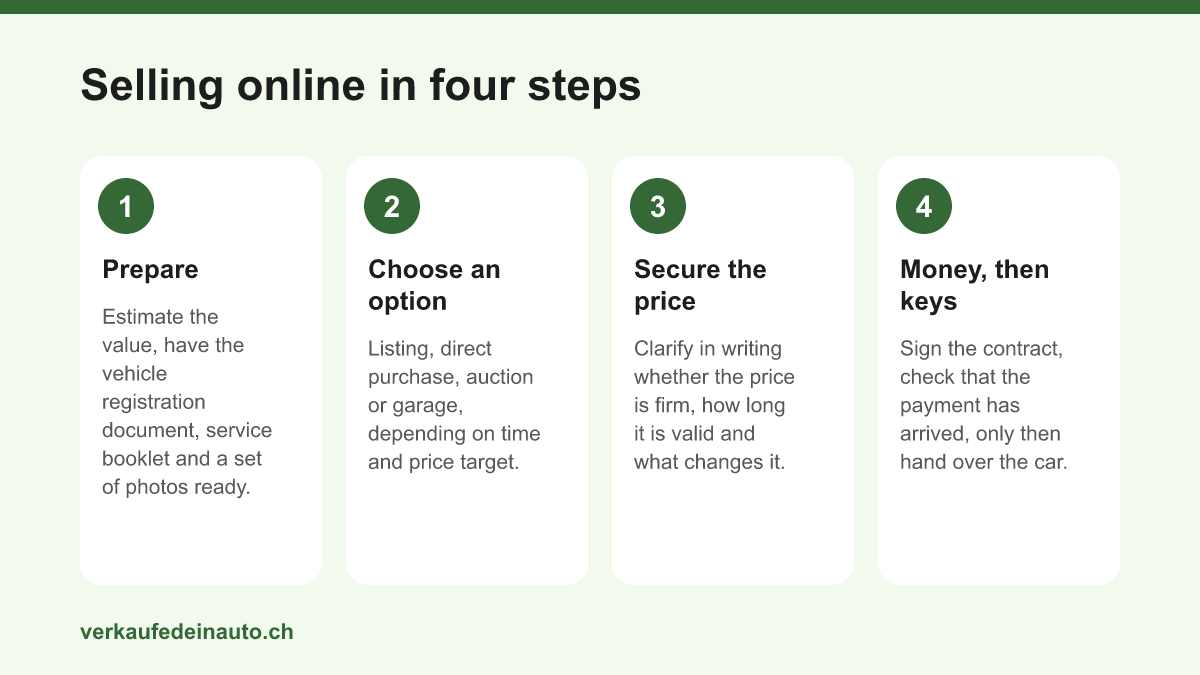
Which online option suits you?
If you want to sell your car online, it’s best to choose based on your time, price target and willingness to take risks:
- Time and a car in demand: listing.
- Fixed price without viewings: direct purchase with a binding offer.
- Several dealer prices at once: dealer auction, provided the car is yours and unencumbered.
- Next car from the garage: trade-in offer, with a second price for comparison.
- Leased car: clarify the settlement amount first, see Selling a leased car.
- No valid MFK (vehicle inspection), high mileage or damage: ask car buyers that expressly take such cars. Export is often the right market.
You can also combine options, for example by getting a firm offer and listing the car at the same time. But don’t accept anything binding while you are still negotiating elsewhere. And before you commit, you should know roughly what your car is worth. For help with this, see the guide How much is my car worth?
verkaufedeinauto.ch falls under the second option and works with a firm offer. It is based on the information you enter in the form and your photos; if they are accurate, the quoted price stands at the handover. The money arrives at the handover by instant bank transfer, smaller amounts in cash on request, and the deregistration at the road traffic office (Strassenverkehrsamt) is included. Leased cars, cars for export and cars without a valid MFK, with high mileage or with damage are bought too. Get your offer as a benchmark before you decide on an option.
Frequently asked questions
Where can I sell my car online in Switzerland?
There are four types of providers: marketplaces such as AutoScout24, tutti.ch or anibis.ch, where you list the car yourself; online car buyers, who buy directly; bidding platforms such as AutoScout24 Direct, where dealers place bids; and garages that accept purchase or trade-in requests through their website.
How quickly do I get the money when I sell online?
With a listing, it depends on when a buyer turns up. With a direct purchase, an auction or a garage, it usually takes a few days until the handover. As for the payment itself: an instant bank transfer is executed within seconds and around the clock, even on weekends, provided the buyer’s bank offers it. A regular transfer takes longer. Only hand over the keys and the vehicle registration document (Fahrzeugausweis) once you see the amount in your own e-banking.
Is an online offer for my car binding?
That depends on the wording. An online valuation or price indication is usually expressly non-binding; the price is then only fixed after an on-site inspection. A firm offer with a validity period, on the other hand, binds the provider until the deadline expires. With dealer auctions, bids can be binding under the platform’s rules, for you too, as soon as you accept. If in doubt, ask in writing.
What does it cost to sell your car online?
With a listing, there is a fee depending on the platform and package, plus your time for inquiries and appointments. Online car buyers and garages usually don’t charge a fee. In return, they offer less than a private buyer, because they have to make money on the resale. Bidding platforms may charge a fee if the sale succeeds. Also factor in additional costs, such as an MFK before a private sale, and ask whether the deregistration is included.
Can I sell a leased car online?
Not without the leasing company, because the car belongs to it. The vehicle registration document shows this with Code 178, “change of ownership prohibited” (Halterwechsel verboten). A sale therefore always involves paying off the lease: only once the settlement amount has been paid does the leasing company have the entry deleted. Some bidding platforms require the car to be owned free of encumbrances. Car buyers that take on leased cars settle up directly with the leasing company.
Sources
- Swiss Crime Prevention (SCP): Classified ad fraud (in German)
- AutoScout24 Direct: How the auction works (in German)
- AutoScout24 Direct: General terms and conditions (in German)
- AMAG: AMAG buys your car
- Code of Obligations (CO, SR 220), Art. 3 and 7
- SIX and SNB: Market launch of instant payments in Switzerland