Fully comprehensive or partial cover? How to optimize your car insurance
The older your car, the less own-damage cover pays out if the worst happens. When fully comprehensive cover makes sense, what partial cover includes and how to lower your insurance premium.
In short
- Liability insurance is mandatory; own-damage cover is optional unless a lease requires it.
- Own-damage cover pays at most current value: with age, the benefit falls, the premium hardly.
- Levers: adjust your cover, deductible, mileage, partner garage, compare quotes.
Fully comprehensive or partial cover: this question doesn’t just come up when you take out a policy; it comes up again every year. Your car loses value, but the premium doesn’t fall at the same pace. At some point, you’re paying for cover that would pay out very little if the worst happened. This guide shows what liability insurance, partial cover and fully comprehensive cover pay for, which cover suits your car’s age and value, and how to lower your premium without saving in the wrong place. It provides general guidance; what counts are your policy and the insurance terms and conditions (AVB).
Liability, partial and fully comprehensive cover: what covers what?
| Cover | Pays for | Mandatory? |
|---|---|---|
| Liability insurance | damage you cause to others with the car | yes, by law |
| Partial cover | your own car: theft, fire, hail, glass breakage, animals, martens | optional |
| Fully comprehensive cover | partial cover plus collision, even if you caused it | optional, usual with leasing |
Liability insurance is mandatory (Art. 63 SVG) and must cover at least CHF 5 million per accident. It is the car that is insured, not the person at the wheel: it doesn’t matter who was driving. However, liability insurance never pays for damage to your own car.
“Fully comprehensive” is not a separate component but the combination of partial cover and collision cover. A difference with consequences: for liability insurance and collision cover, the premium usually depends on your claims history. This bonus-malus system works differently from insurer to insurer, but a claim can make the following years more expensive. Partial cover has no such system. What exactly counts as a partial cover claim, for example in the case of vandalism, varies from provider to provider.
When fully comprehensive cover is required: leasing and loans
Only liability insurance is required by law. However, the contract you use to finance the car can require fully comprehensive cover. With leasing, the car belongs to the leasing company, which as a rule requires fully comprehensive cover. The exact rules are set out in the leasing terms. If you take over the car at the end of the lease, you decide on the cover again. How to get out of an ongoing contract is shown on the page Selling a leased car.
If you bought the car with a loan, it usually belongs to you. Whether the lender requires own-damage cover (partial or fully comprehensive) is stated in the loan agreement. It still makes sense as long as a total loss would leave you with debts but no car.
Fully comprehensive or partial cover: the car’s value decides
In the event of a total loss or theft, own-damage cover without a special add-on does not pay the price when new but the current value: what your car was still worth immediately before the damage, depending on its age, mileage and price when new. The deductible is subtracted from this. The maximum possible payout from collision cover therefore falls every year along with the car’s value.
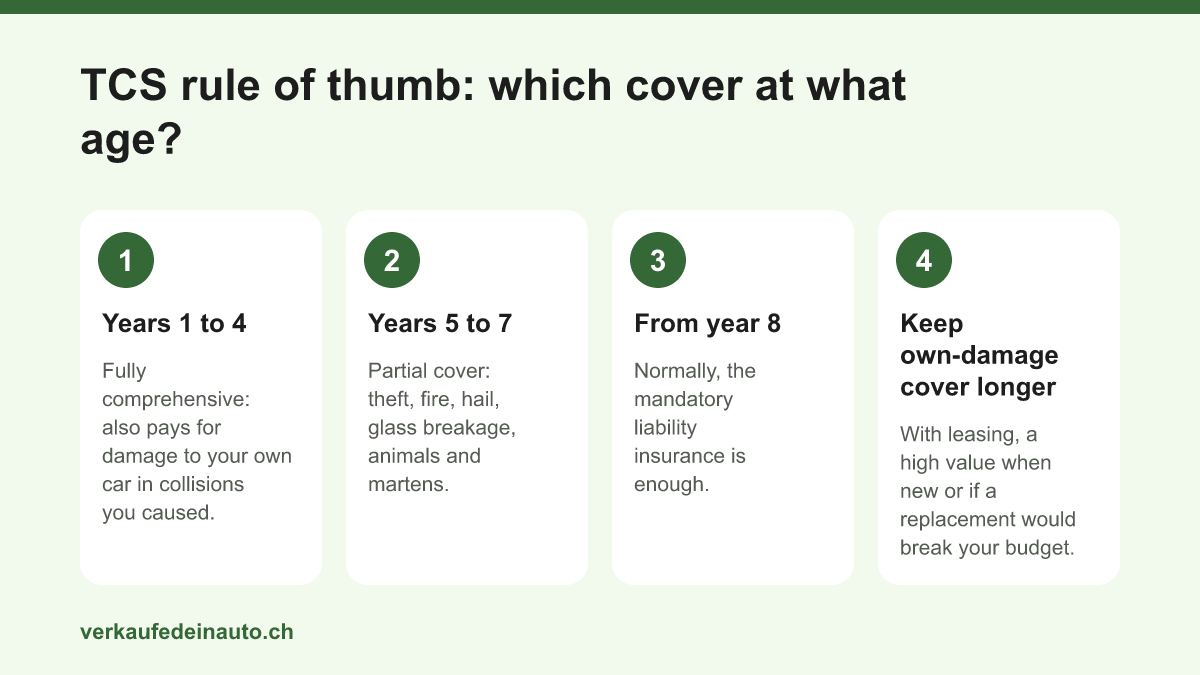
From this, the TCS derives a rule of thumb: fully comprehensive cover is usually worth it up to and including the fourth year on the road, partial cover up to and including the seventh. If the car is older, liability insurance is normally enough. If the car was worth over CHF 75’000 when new, partial cover can make sense for longer, as it can if the car is often parked outdoors.
What is your car worth?
Get a free offer without obligation in a few minutes.
Your own calculation: three questions before switching
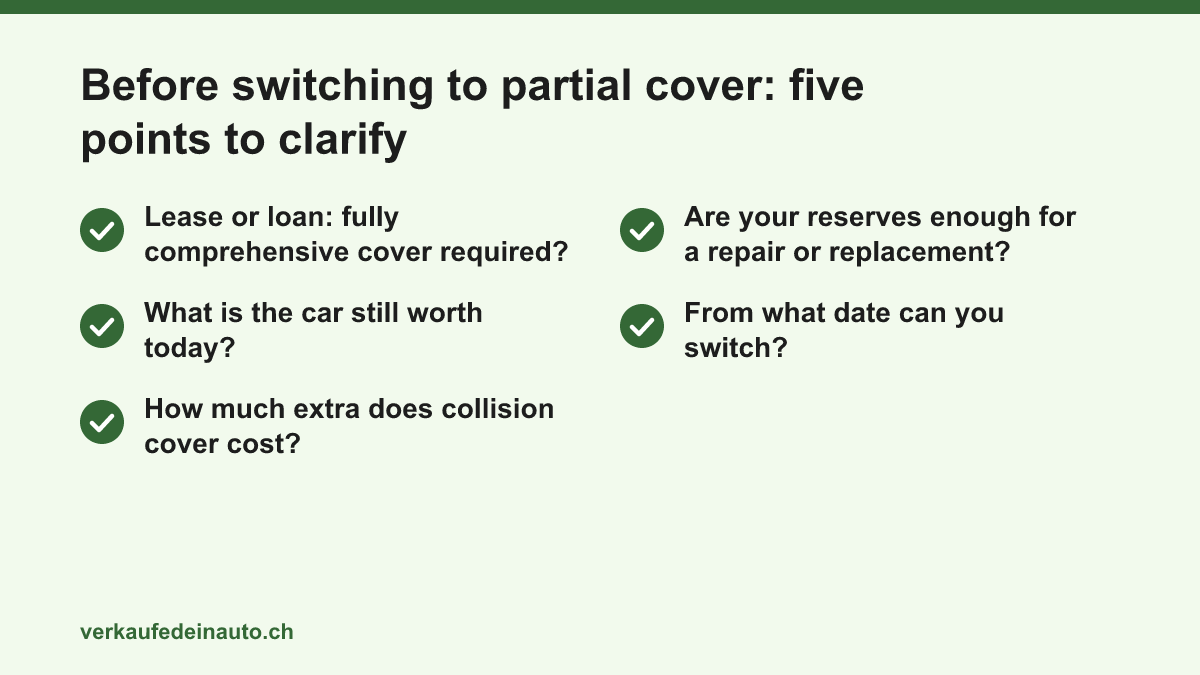
A rule of thumb is no substitute for your own calculation. Three questions help:
- What is the car worth today? The guide to the free car valuation gives you a realistic figure. Which factors count is explained under Used car value in Switzerland.
- How much more does collision cover cost per year? Ask for the premium to be shown with and without this component.
- Could you afford a total loss yourself? If you depend on the car and have no reserves for a replacement, you’re better off keeping fully comprehensive cover for longer.
Worked example with round figures: Your car is still worth CHF 8’000, collision cover costs an extra CHF 600 per year, and the deductible is CHF 1’000. In the worst case, you get at most around CHF 7’000. For this protection, you pay almost a tenth of that every year, and the possible maximum keeps shrinking. Fully comprehensive cover does also pay for smaller collision damage, but only above the deductible and often with consequences for your bonus. For a car worth CHF 30’000, the same calculation looks quite different.
Add-ons: what helps and what is often covered twice
- Current value add-on: increases the compensation for a total loss beyond the current value, according to the TCS usually by around 20 percent in the first years on the road. Worth considering for newer cars, because the value falls fastest at the beginning.
- Bonus protection: Depending on the insurer, the premium stays the same after one claim per year, rarely after two. If you pay for small damage just above the deductible yourself, you save the protection for a major claim.
- Gross negligence: If you caused an accident through gross negligence, the insurer may reduce the payout from your own-damage cover (Art. 14 VVG) and take recourse against you under liability insurance (Art. 65 SVG). With this add-on, the insurer waives these rights, but usually not in cases involving alcohol, drugs or extreme speeding offenses.
- Parking damage: covers damage that unknown persons cause to your parked car, usually only for newer cars and with limits on the number of claims and the amount. Without this add-on, collision cover pays, with a deductible and possibly consequences for your bonus.
If you have no own-damage cover at all, you can still turn to the National Guarantee Fund (Art. 76 SVG) for parking damage caused by unknown persons. It requires a police report and applies a deductible of CHF 1’000 where only property is damaged.
Often insured twice
You are often insured twice for three components: occupant accident cover (if you live in Switzerland, you are covered through your accident insurance or health insurance), breakdown assistance (often already available through a motoring club) and belongings carried in the car (often through your household contents insurance).
Optimize your car insurance: honest ways to lower the premium
How much you save depends on your car, your profile and the provider. Reliable franc amounts can’t be given across the board, but the levers are clear:
- Match the cover to the car: the first lever, see above.
- Deductible: The higher it is, the lower the premium. Only choose an amount you could really pay in the event of a claim.
- Annual mileage: If you drive little, you pay less. Give a realistic number of kilometers.
- Choice of garage: If you commit to having damage repaired at one of the insurer’s partner garages, the premium goes down.
- Parking and payment method: A garage space instead of the street and annual instead of installment payments also have an effect.
- Savings models: Options such as “sole driver” or a drive recorder lower the premium but attach conditions to it. Check what happens if you don’t meet them.
- Compare quotes: with the same cover and the same deductible; otherwise you’re comparing apples and oranges. Policies taken out online are often cheaper, but they come without personal advice.
Tip
Don’t switch from fully comprehensive to partial cover until spring. The TCS advises this so that damage from the winter is still covered.
Cancellation dates: when you can switch
A better quote only helps if you can get out of your old contract. The usual opportunities:
- when the contract expires, usually with three months’ notice
- at the end of the third year of the contract at the latest, and every year after that (Art. 35a VVG)
- after a claim that the insurer has paid for (Art. 42 VVG)
- when the premium goes up, if the terms and conditions provide for this
- when you change cars
Notice periods and form requirements are explained in the guide Canceling your car insurance. It also explains what happens to the policy when you sell your car: you have it transferred to your next car, suspended with the plates deposited, or canceled, and any overpaid premium is refunded pro rata.
When the insurance no longer suits the car
Sometimes the calculation shows more than the right cover: if the premium, taxes and upcoming repairs are out of all proportion to the car’s value, selling it is an option. Whether the time is right is shown in the guide The best time to sell your car. verkaufedeinauto.ch makes you a firm offer based on your information and photos, including for cars with high mileage, without a valid MFK (vehicle inspection) or with damage. Payment is made at the handover by instant bank transfer, and the deregistration at the road traffic office (Strassenverkehrsamt) is included.
Request your free offer here and compare it with what the car costs you per year.
Frequently asked questions
At what age is fully comprehensive cover no longer worth it?
There is no fixed limit. As a rule of thumb, the TCS names the fourth year on the road: after that, the ratio between the premium and the possible compensation becomes less favorable, because own-damage cover only pays the current value in the event of a total loss. Keep fully comprehensive cover for longer if the car is leased or had a high value when new, or if you couldn’t absorb a total loss from your own funds. Base your calculation on your car’s current value, not the purchase price.
What is the difference between fully comprehensive cover and collision cover?
Collision cover pays for damage to your own car caused by a collision, even if you caused it yourself. Partial cover protects against events such as theft, fire, hail, glass breakage and collisions with animals. Together, the two are called fully comprehensive cover. Insurers usually don’t offer collision cover on its own, without partial cover. Damage you cause to others is always covered by the mandatory liability insurance.
Does partial cover pay for parking damage?
No, not if an unknown vehicle hit your parked car. That is collision damage and falls under fully comprehensive cover or the parking damage add-on. Without these covers, you can turn to the National Guarantee Fund: it covers damage caused by vehicles that cannot be identified, but it requires a police report and applies a deductible of CHF 1’000 where only property is damaged. So report the damage to the police immediately.
Do I have to take out fully comprehensive cover when leasing?
As a rule, yes. The law only requires liability insurance, but the leasing company, as the owner, requires fully comprehensive cover in the contract. Switching to partial cover is therefore only an option once the contract has ended or been settled, or if the company expressly agrees. Read the insurance clause in your leasing terms and, if in doubt, ask in writing.
Can I switch from fully comprehensive to partial cover in the middle of the year?
That depends on your contract. The terms and conditions (AVB) may, for example, only allow the cover to be reduced after a minimum term or at the end of the insurance year. Ask your insurer from what date collision cover can be removed and how much premium you will get back. The TCS advises waiting until spring to switch so that winter damage is still covered. For a leased car, you need the leasing company’s consent.
Sources
- Road Traffic Act (SVG), Art. 63, 65 and 76 – Fedlex (in German)
- Insurance Contracts Act (VVG), Art. 14, 35a and 42 – Fedlex (in German)
- TCS: Liability, partial or fully comprehensive cover? (in German)
- TCS: Additional cover options for car insurance (in German)
- TCS: Tips for saving on car insurance (in German)
- Swiss Insurance Association (SVV): Dealing with expensive car damage through the right motor vehicle insurance (in German)